Rockets are usually discussed in terms of engines, payloads, launch performance, and a myriad of other engineering statistics. All the facts that get you from the ground, all the way into space. But what about the facility that produces the rocket?
Starfactory is a facility that asks a different question. How do you build enough rockets, at a speed fast enough, to make the colonization of our solar system truly possible?
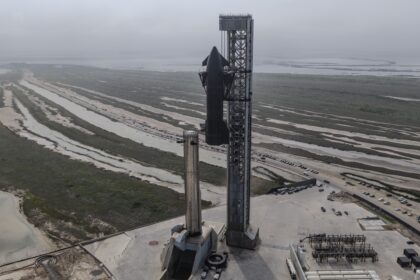
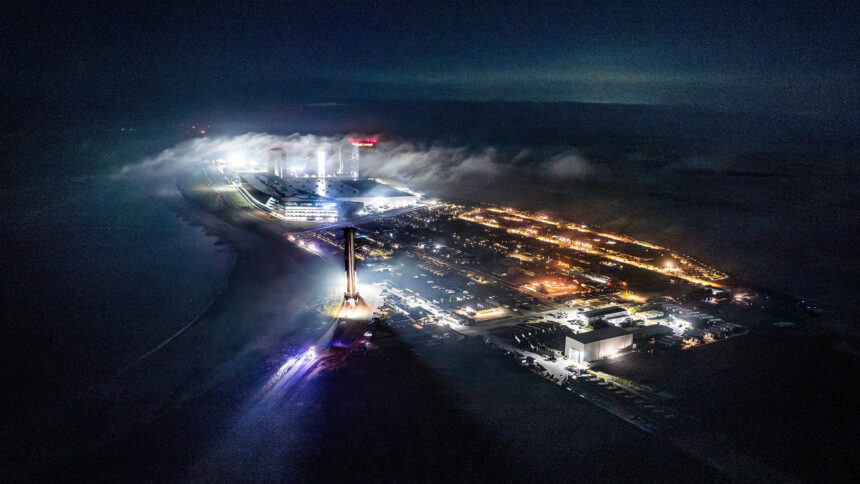
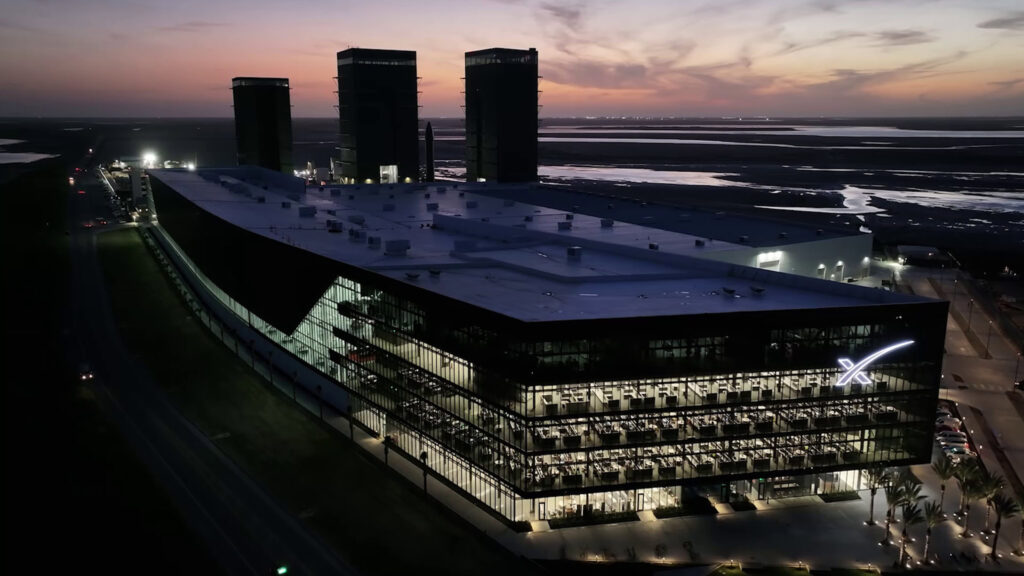
SpaceX built Starfactory at Starbase, its South Texas headquarters, manufacturing centre, test site, and launch complex for Starship. The facility brings the majority of Starship and Super Heavy Booster‘s production under one roof, with the goal to support high-volume production of both stages.
SpaceX’s goal with Starfactory is to build 1,000 Starships (and their Super Heavy Boosters) per year.
It isn’t a new rocket, launch pad, or separate SpaceX endeavour, and while factories might sound boring at first glance, it is the home of SpaceX’s ambition to make Starship rapidly reusable.
Where is Starfactory?
Starfactory is part of Starbase (the incorporated community), in Cameron County, Texas, near the Gulf Coast. The broader facility includes engineering offices, production facilities, test stands, launch infrastructure, and recovery equipment.
A vehicle can move from production to integration, then to ground testing, and finally to launch, all without needing to be shipped across the country. Engineers can compare data from the most recent flights, and make immediate improvements on the hardware being put together in the next building over.
Why Starfactory?
Early Starship prototypes were assembled in a collection of tents, temporary structures, and large vertical bays. That approach suited a development program that was testing the simple feasibility of an idea, as it changed constantly. Teams could build a tank, test it, learn from the failure, and improve the next model.
An operational fleet of Starships requires something a bit more permanent and repeatable. Starship is designed around full and rapid reuse, but that doesn’t eliminate the need for production, especially when the goal is to launch one Starship an hour.
Vehicles will be lost during development, some missions may expend hardware, new improvements will replace old ones, and a high flight rate requires ships and boosters to keep operating while others are inspected or refurbed.
SpaceX also needs to be able to build out its whole host of specialized Starship variants. The plan includes cargo ships, propellant tankers, orbital depot ships, and NASA’s Starship Human Landing System (HLS). They share a basic design and platform, but they all need specific hardware. Starfactory is what puts that all together.
Building a Starship
While Starship and Super Heavy may seem simple with their stainless-steel bodies, there is a complex production process at work behind the scenes. Large steel sections are formed into rings and welded together to create the body, while domes and bulkheads divide the internal tanks of liquid methane and liquid oxygen.
Finally, the Raptor engines are integrated in the aft section. On a ship intended to return to Earth, thousands of heat-shield tiles cover one side of the ship, while the four massive flaps provide control during reentry. Meanwhile, Super Heavy needs tanks, avionics, grid fins, and an extremely dense cluster of Raptors, plus all the new interfaces for hot staging, tower handling, and recovery.
Not all of that work happens in a fixed order today, as Starship and Super Heavy’s production line is as much of a developmental process as the flight tests are. SpaceX is still working to standardize the subsystems of both the upper and lower stages, and ensure that each ship and booster is less of a unique and individual project.
One Name, Many Buildings
While Starfactory sounds like it’s one building, it’s actually the name used loosely for all Starship related construction at Starbase. Officially, its description indicates several specific facilities.
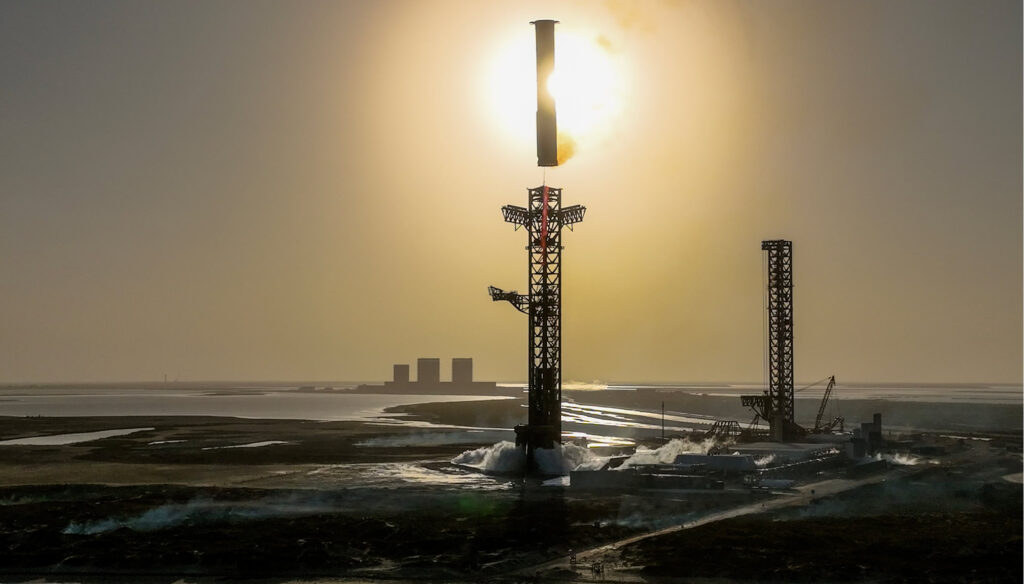
Starfactory itself handles the high-volume component and vehicle production, which includes large vertical buildings that support stacking, integration, and refurb. In addition, it also includes the test stands that handle static fires and other testing, as well as the tank farm and launch pads.
Gigabay
SpaceX’s future plans also include Gigabay, a large vertical integration building which will be designed to support future iterations of ships and boosters, up to 116 meters (~380 feet) tall. The Gigabay will include 24 work cells for part integration and refurbishment.
Turning Stainless Steel into Rockets
Starship’s stainless-steel is more than just an aesthetic choice. Steel is strong across a wide range of temperatures, and can be welded using simple industrial processes rather than complex work needed to bind exotic materials together. It can also tolerate the extremely cold temperatures and specific pressures needed to store cryogenic propellants.
That makes Starship’s design easier to develop, but not necessarily easier to build. The long welds across the cryogenic tanks need to hold propellants under pressure, while the whole thing still needs to remain light enough to fly and bring mass to orbit.
SpaceX’s largest challenge is making the production process repeatable with consistent parts, welds, and a design that can be made time and time again, without deviation between ships.
Vertical Integration of Testing
Starship’s design is intentionally iterative. SpaceX builds the hardware, tests it, flies it, and then studies the result, all to produce a better next ship. High throughput, locally, means that the cycle can go faster. Engineers can make minor changes to ships on the line now, and make larger redesigns for later variants.
More hardware being locally available also provides SpaceX the ability to test faster, as regulators know what to expect, when to expect it, and how often SpaceX plans to fly.
Starship’s entire economic case, being built around rapid reusability and moving large amounts of mass to orbit quickly, hinge on two things. The first is the viability of Starship itself, which SpaceX is in the process of proving today. The second, less visible factor, is just how efficient and productive Starfactory will be.