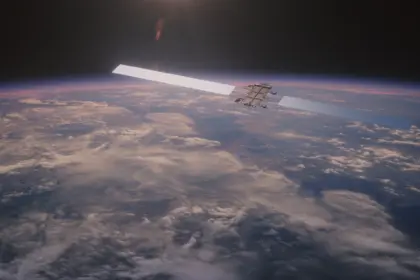

The Federal Communications Commission adopted an order on 30 September 2026 that opens more than 1,000 megahertz in the 12.7 GHz and 42 GHz bands for satellite service. Starlink and other satellite operators can seek authorization to use the newly available spectrum, but the order does not immediately add capacity to existing networks. Operators must first receive authority and then deploy satellites and terminals capable of using the new frequencies.
What the Order Opens
The FCC’s September open-meeting page says the order would unlock more than 1,000 megahertz across the two bands, providing additional spectrum for satellite broadband to homes and in-flight connectivity. The item includes a report and order, an order of proposed modification, and two further notices. The listed dockets are SB Docket Nos. 25-180 and 26-54, GN Docket Nos. 14-77 and 22-352, and WT Docket No. 23-158.
The FCC fact sheet identifies the 12.7-13.25 GHz band as 12.7 GHz and the 42-42.5 GHz band as 42 GHz, with 500 MHz available in each band..
Home Downlink and Gateway Downlink
The FCC order divides the permitted uses between the two bands. In the 12.7 GHz band, fixed-satellite service (FSS) operations are permitted for both uplink and downlink. The order allows FSS uplinks from individually licensed gateway and feeder-link earth stations to geostationary (GSO) and non-geostationary (NGSO) satellites, including low Earth orbit (LEO) satellites such as those used by Starlink.
The order also allows uplinks from earth stations in motion (ESIMs) aboard aircraft and maritime vessels to GSO satellites, along with downlink transmissions from NGSO satellites to blanket-licensed user terminals, including ESIMs.
In the 42 GHz band, FSS downlink is permitted to individually licensed satellite gateways and feeder-link earth stations. The existing primary allocation for terrestrial fixed service stations is maintained, while terrestrial mobile service becomes secondary.
For Starlink, it remains unclear how much of this spectrum could benefit the existing network. Traditional Starlink user terminals do not fit the uplink permissions, while the Starlink constellation primarily operates in NGSO. The downlink provisions are more closely aligned with Starlink and Starlink Mobile and could potentially be supported by future hardware.
The spectrum could also become relevant as Starlink expands its mobile services and combines satellite connectivity with traditionally ground-based network infrastructure.
FCC Chairman Brendan Carr described the goal in remarks carried by Via Satellite:
Making next-gen satellite broadband faster and more reliable will not only benefit current subscribers but also enhance competition for all consumers.
Carr also said the action could expand spectrum access for earth stations in motion, including those used by drones, ships, planes, and vehicles. That is a potential future use rather than an immediate expansion of service. Operators would still need authorization and compatible hardware before using the spectrum.
Future Spectrum for Expansion
The same morning, the Commission also asked for comment on spectrum that was not opened by this order. Several further notices cover the opening of additional Ku- and Ka-band spectrum, along with the comment of primary allocation of 138.25 gigahertz in the D-band.
A second further notice asks about bands for spacecraft control and missions such as in-space servicing, assembly, and manufacturing. A separate vote that morning covering environmental review for many space licensing actions was also unrelated to the spectrum authorization.
The next question is whether SpaceX files to use the 12.7 GHz or 42 GHz bands and whether future satellites or user terminals can operate on the new frequencies. Other satellite operators can seek the same spectrum. Until an operator receives authorization and deploys compatible hardware, the additional megahertz represents an opportunity to add capacity rather than capacity already available to customers.







![Falcon 9 to Launch SDA Tranche 1 Transport Layer A [Scrubbed]](https://thegridfin.com/wp-content/uploads/2026/07/SpaceX_SLC_4E_01-150x150.jpg)