There’s a lot that goes into a Starship flight, and it isn’t just the mission planning, payload, or launch. There’s a massive series of events that has to play out perfectly between Starship arriving at the pad, taking off, and then returning home.
Preparing the Stack for Launch
A Starship flight begins long before ignition. The Starship spacecraft is stacked above its Super Heavy booster beside the launch tower, and ground systems load both stages with chilled liquid oxygen and liquid methane. These cryogenic propellants must be kept cold and managed carefully as the countdown progresses.
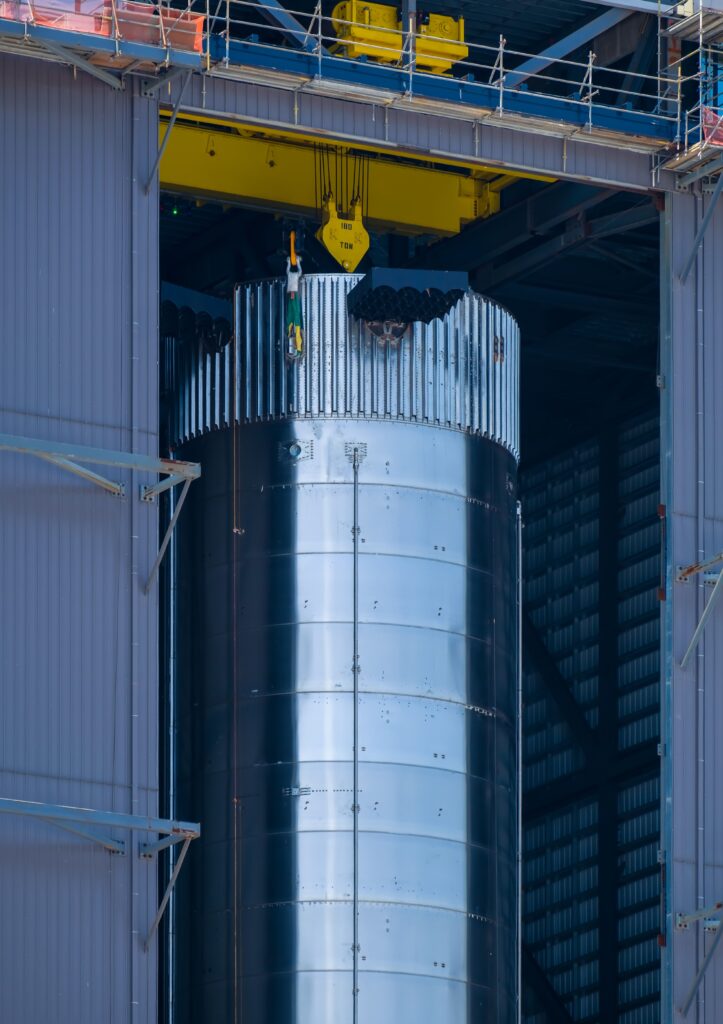
The launch site is part of the vehicle architecture. Tank farms store propellant, the tower supports stacking and recovery operations, and the pad’s water-cooled flame-management system helps protect surrounding hardware from the exhaust and acoustic energy produced at ignition. Automated health checks continue throughout the entire propellant loading sequence. A launch can be held or aborted if the rocket, ground equipment, weather, or range is outside acceptable limits.
For now, given Starship’s early status in development, the precise launch schedule and test objectives vary from flight to flight. SpaceX publishes a mission-specific timeline for each test, while the Federal Aviation Administration licenses the particular launch operation.
From Liftoff to Hot-Staging
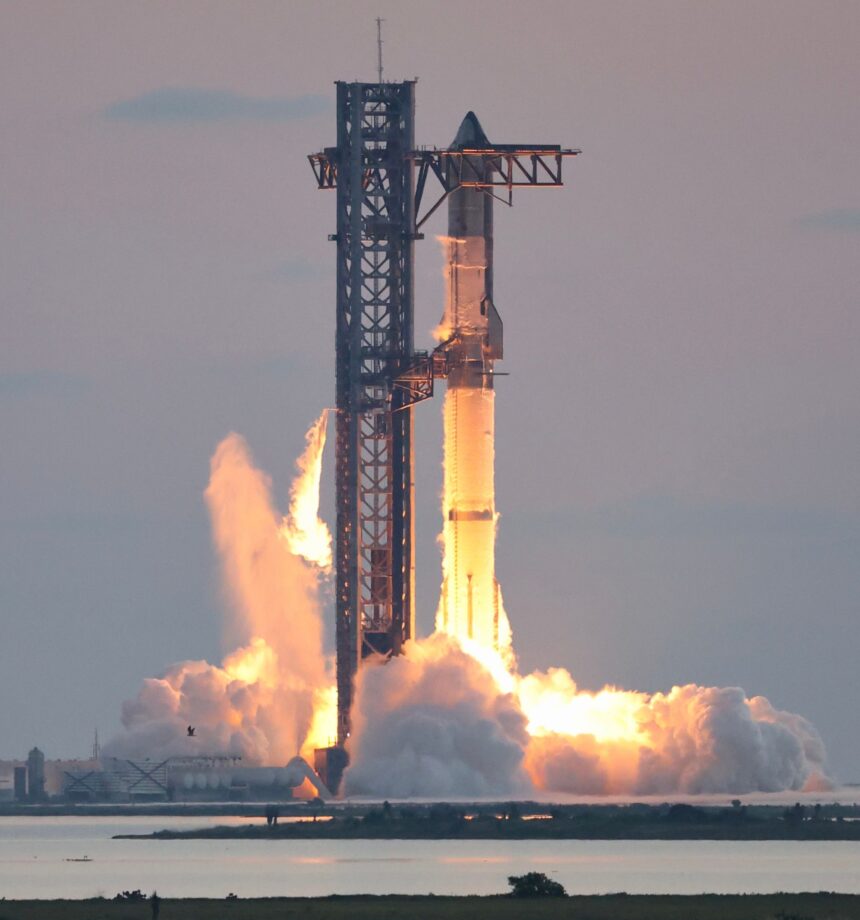
At ignition, Super Heavy’s Raptor engines build thrust and lift the complete stack from the pad. The booster does most of the early work, pushing the rocket through the lower atmosphere and past max Q.
Max Q is the point where aerodynamic forces on the vehicle reach their peak.
A little over two minutes into the average test-flight profile, most booster engines shut down. Starship then lights its engines while still attached, and the stages separate in a manoeuvre called hot-staging. The exhaust passes through the booster’s vented interstage as the ship pulls away. Keeping thrust during separation improves performance compared with a longer unpowered coast.
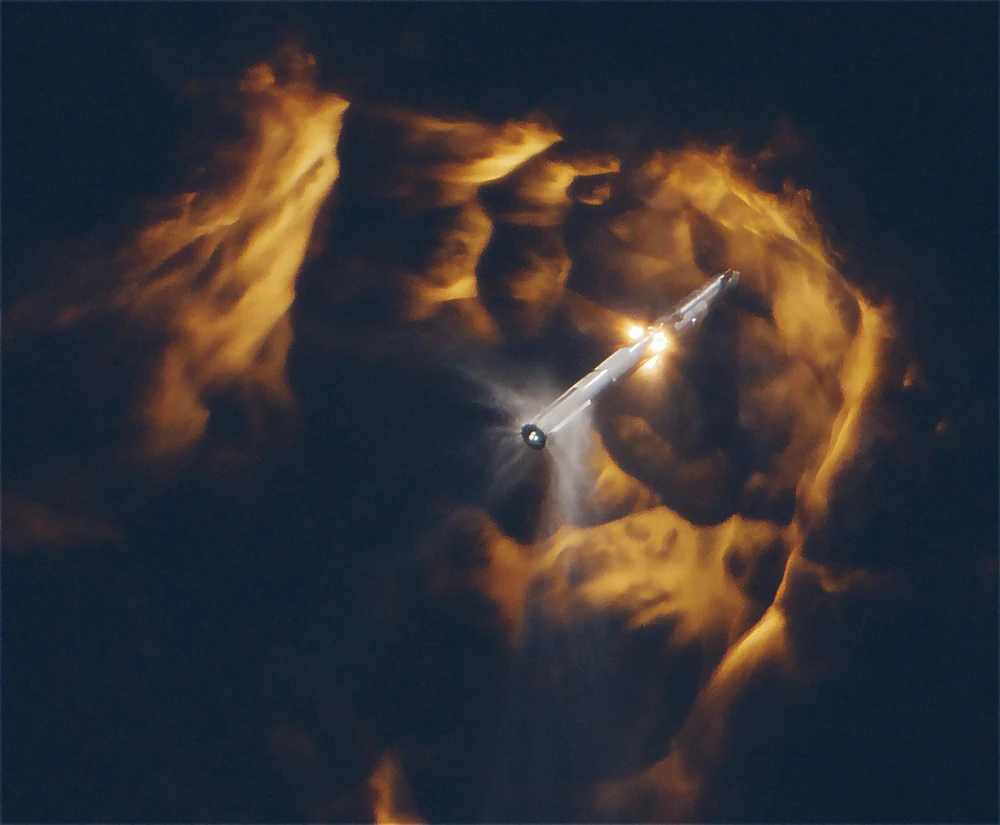
The two vehicles now have different jobs. Super Heavy turns toward its recovery profile, while Starship continues accelerating on a long arc toward space. The ship uses sea-level Raptor engines and vacuum-optimized Raptors, which have larger nozzles designed to work efficiently at high altitude.
Current flight tests have followed suborbital or near-orbital trajectories designed to achieve test objectives without leaving the ship in a lasting orbit. That difference matters a lot for the mission. Travelling at orbital-class speed and crossing space are not the same as entering and maintaining a stable orbit.
What Starship Does in Space
After engine cutoff, Starship coasts through space. Depending on the mission, an operational ship could deploy satellites or other payloads, manoeuvre, rendezvous with another spacecraft or prepare for a later burn. SpaceX has used flight tests to demonstrate pieces of that sequence, including payload-deployment tests and in-space engine relight attempts or demonstrations.
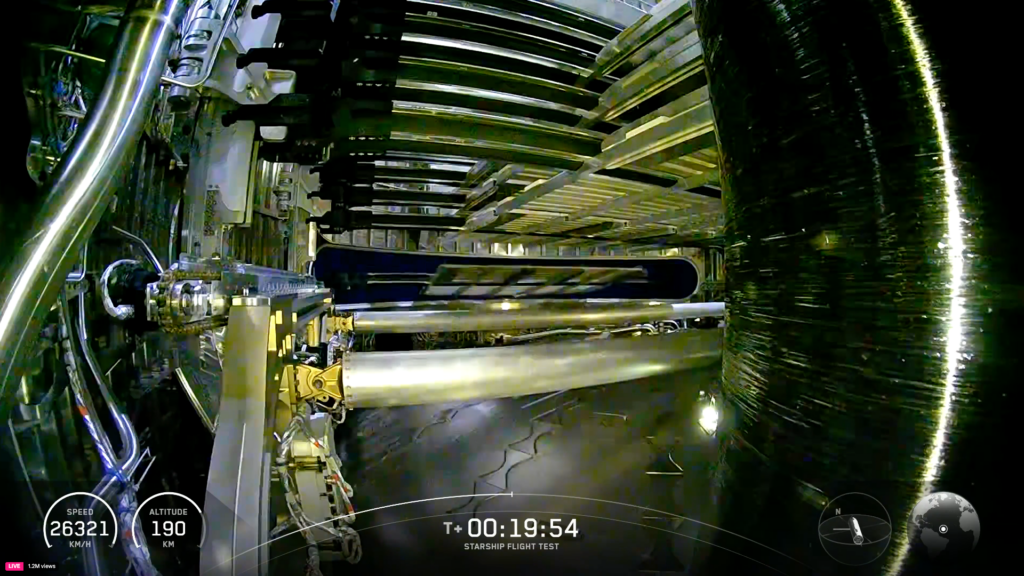
More ambitious missions require capabilities that are still being developed. A Starship headed beyond low-Earth orbit is expected to meet tanker or depot vehicles and receive cryogenic propellant in space. NASA and SpaceX are developing this architecture for the Starship Human Landing System, but large-scale vehicle-to-vehicle transfer is not yet a routine, operational capability. Crewed flights would also require life support, human-rating work, and mission-specific certification.
This flexibility is central to the design. The same broad vehicle family is meant to support satellites, cargo, tankers, lunar systems and eventually crews. While these various types of Starship aren’t interchangeable, they’ll all be essential to the mission of expanding human consciousness to the stars.
Returning Both Stages
While Starship continues downrange, Super Heavy may boost back toward the launch site or target an offshore landing area. Grid fins steer it through the atmosphere, and a landing burn removes the remaining speed. If vehicle and tower conditions permit, the booster can approach the launch tower for a catch by its mechanical arms. Our separate Super Heavy guide explains that sequence in detail.
The ship’s return is longer and hotter. It enters the atmosphere heat-shield-first, using four flaps to control its attitude and path. At low altitude, it is designed to transition from a horizontal descent into an upright landing burn. Test flights often target a controlled ocean splashdown rather than recovery, because the program is still proving the thermal protection, control and propulsion needed to bring the spacecraft home intact.
A complete operational cycle would end with both stages recovered, inspected, refuelled and flown again. SpaceX has demonstrated important portions of that cycle, including booster catches, a booster reflight and controlled ship descents. It has not yet turned the entire sequence into routine recovery and rapid reuse of both stages.
That’s where the promise of reusability with Starship lies, and where SpaceX constantly challenges cutting-edge materials science and engineering.






![Falcon 9 to Launch SDA Tranche 1 Transport Layer A [Scrubbed]](https://thegridfin.com/wp-content/uploads/2026/07/SpaceX_SLC_4E_01-150x150.jpg)