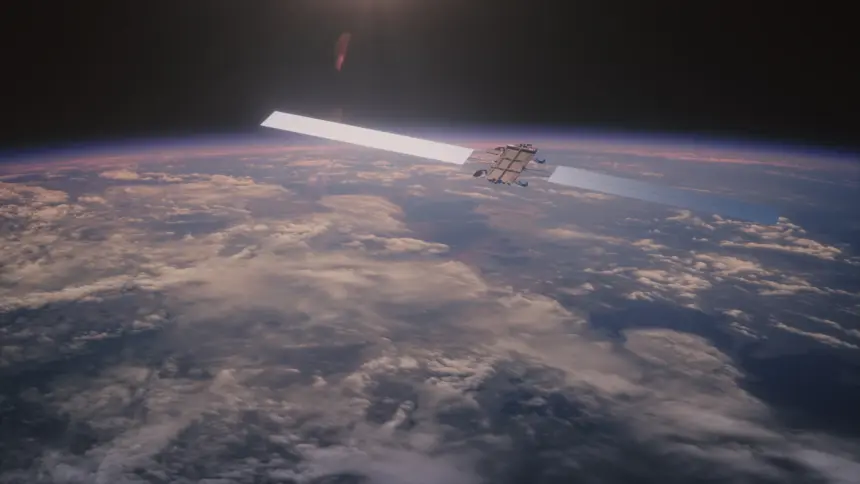
On Oct. 6, 2026, SpaceX published a Space Safety page that puts the Starmind constellation’s scale into writing. SpaceX’s new constellations plan for 100,000 Starlink satellites and up to 1 million Starmind AI satellites for broadband and space-based supercompute.
The same day, SpaceX SVP Michael Nicolls spoke on space safety and ephemeris sharing at the International Astronautical Congress in Türkiye. To double down on his points about safety, SpaceX also released close-approach footage from low Earth orbit.
However, we cannot mitigate risk when another operator maneuvers without sharing a predicted trajectory that includes the burn.
This is the biggest risk in LEO pic.twitter.com/5sqbmW1aD7
— Starlink (@Starlink) October 6, 2026The FCC has accepted SpaceX’s up-to-1-million-satellite application for filing, but has not provided an approval or license grant yet. SpaceX has more than 11,000 Starlink satellites in LEO today, and the first 26 Starlink V3s went up at the end of September 2026.
SpaceX intends to have thousands of units of Starlink V3s being produced at its Bastrop facility by late 2027, but that’s still a hopeful leap from the early production of just a handful at this point. Starmind itself won’t be deploying until late next year, and requires the much larger Starship to be fully functional for deployment of the Gigasats.
Constant communication is what makes autonomy like this safe. Early contact lets us take maneuvering responsibility, publish ephemeris faster than ground radar can catalog the object, and deorbit and keep commanding through demise if needed
We treat early communications as a requirement, not a nice-to-have
— Starlink (@Starlink) October 6, 2026Clusters of About 10 Sats, About 10 Tbps Per Cluster
Nicolls gave the clearest public picture yet of how Starmind would fly. At IAC he said SpaceX needs clusters of satellites in tight formation for coherent compute, and that a cluster will be “10-ish satellites connected with 10 terabits or so of bandwidth between them, and interconnected to the broader constellation.”
SpaceX is likely to use the compute internally, or offer compute to other companies that it has signed compute contracts with already. What we’re not sure about is what the first cluster will cost in comparison to an equivalent ground-based datacenter.
SpaceX has just released a new look at what their 1 million Starmind satellites constellation might look like (dots do not represent true size of sats).
SpaceX VP @michaelnicollsx said today: "We need to operate clusters of satellites in tight formation to get enough coherent compute to run AI models efficiently. A cluster will be 10-ish satellites connected with 10 terabits or so of bandwidth between them, and interconnected to the broader constellation."
— Sawyer Merritt (@SawyerMerritt) October 6, 2026164,000 Conjunction Cases and Half the Ephemeris
The Space Safety page’s safety case is ephemeris sharing. Ephemeris sharing is the act of providing other satellite operators with the planned manoeuvres and path of your satellites, to help prevent collisions in orbit.
In 2026, Starlink encountered conjunctions with about 650 unique manoeuvring third-party satellites; only about half shared ephemeris. Over six months, Starlink observed about 164,000 conjunctions where time of closest approach fell within four hours after an unannounced manoeuvre.
SpaceX says not all were high-risk; they are cases where Starlink lacked enough information to reliably avoid if the other operator created a high-risk conjunction. SpaceX calls policies that block sharing “counterproductive” and says they “largely only serve to create preventable collision risk between satellites.”
While there are tens of thousands of pieces of debris in low Earth orbit, all manmade, we can mitigate risk against these objects if we track them https://t.co/NnyAHwMrwG
— Starlink (@Starlink) October 6, 2026Nicolls framed debris as “obstacles on a road” and said the harder problem is other operators who manoeuvre without saying where they are going. He noted progress sharing data with a Chinese space station and some Chinese operators, but “many, many that we do not.”
Starlink’s Oct. 6 video post put it bluntly: the company cannot mitigate risk when another operator manoeuvres without sharing a predicted trajectory that includes the burn, and calls that “the biggest risk in LEO.”
57 Metres and 134 Metres
Two Starlink cases on the page show how fast a miss distance can collapse. On Oct. 1, 2025, STARLINK-32710 had a predicted miss of about 9 km until roughly 4.5 hours before closest approach. The other satellite manoeuvred and the miss fell to 57 metres.
Stargaze updated the trajectory in under an hour, Space-Safety.com screened it, and Starlink planned a collision-avoidance burn that restored the miss to 1 km.
In August 2026, STARLINK-2140 got updated conjunction data messages with about 30 minutes to closest approach — too late for a propulsive burn. The satellite “ducked” (chassis and solar arrays to knife-edge) and the vehicles passed within 134 metres.
SpaceX has not named the other satellites or operators of those satellites in its Space Safety post.
Stargaze and Free Screening
Starlink’s Space-safety.com remains an option for free screening and coordination. It provides operators a place to upload and download ephemeris, and provides low-latency screening against other uploads and the Stargaze catalogue. It then provides satellite operators conjunction data within a minute of trajectory upload.
Stargaze runs more than 31,000 star trackers on the Starlink fleet, collecting opportunistic optical observations, and resolves and updates orbital solutions every minute as well. Stargaze and Space Safety help to cut down risk from unannounced manoeuvres but cannot erase it. Operators still need to share ephemeris ahead of time.
The risks are high without sharing ephemeris. A satellite collision in orbit can result in small debris scattering across a massive space, resulting in hundreds of other satellites at risk given the speeds of closure.
The result is the Kessler Syndrome, a self-sustaining cycle where pieces of space junk collide with other objects in orbit, generating exponentially more debris, until the risk of collision is so high, humanity is simply locked out of space.
SpaceX has taken the high road when it comes to sharing ephemeris, but it will depend on other operators to follow suit to protect humanity’s future in space.



![Falcon 9 to Launch SDA Tranche 1 Transport Layer A [Scrubbed]](https://thegridfin.com/wp-content/uploads/2026/07/SpaceX_SLC_4E_01-150x150.jpg)