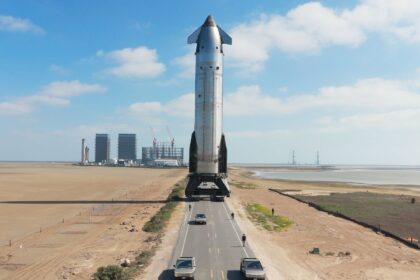
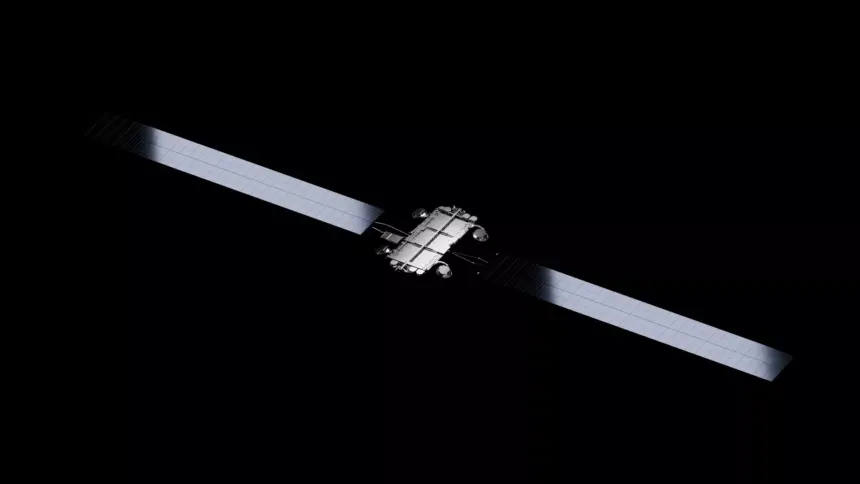
Starlink V3 represents a fundamental redesign of SpaceX’s satellite platform, enabled by Starship’s significantly greater payload capacity. Starlink V2 was designed around the capabilities of Starship, but with the rocket’s development taking longer than expected, SpaceX introduced V2 Mini as a smaller version of the platform that could be launched on Falcon 9.
With Starship providing substantially more payload volume and mass capacity, SpaceX has been able to move beyond the constraints of previous Starlink generations with V3. The result is a much larger satellite with significantly more bandwidth, processing power, communication beams, power generation and networking capability.
Rather than simply modifying the existing V2 Mini design, SpaceX has rebuilt V3 around Starship’s capabilities. The additional space allows each satellite to carry considerably more hardware, providing the capacity needed to support a growing number of users across the Starlink network.
V3 takes bandwidth to the next level
The biggest improvement with V3 is its communications capacity.
| Capability | Starlink V2 Mini | Starlink V3 |
| Downlink | 96 Gbps | 1 Tbps |
| Uplink | 6.7 Gbps | 160 Gbps |
| Downlink beams | 192 | 2,048 |
| Uplink beams | 144 | 2,048 |
V3 is designed to provide roughly 10 times the downlink capacity and 24 times the uplink capacity of V2. The number of communication beams has also increased dramatically, with V3 supporting 2,048 downlink and 2,048 uplink beams. This allows each satellite to distribute its available capacity across far more simultaneous connections.
SpaceX has also upgraded the phased-array antennas and introduced new in-house beamformer chips. The modem chips feeding the phased arrays can handle approximately 64 times more throughput per chip, allowing V3 to serve more customers simultaneously while dynamically allocating capacity according to demand.
For Starlink users, the result should be more capacity per satellite and reduced congestion as the network continues to expand.
Six lasers connect the constellation
V3 also brings a major upgrade to Starlink’s optical inter-satellite links. Each V3 satellite features six 400 Gbps optical links, creating a redundant and high-bandwidth laser mesh network.
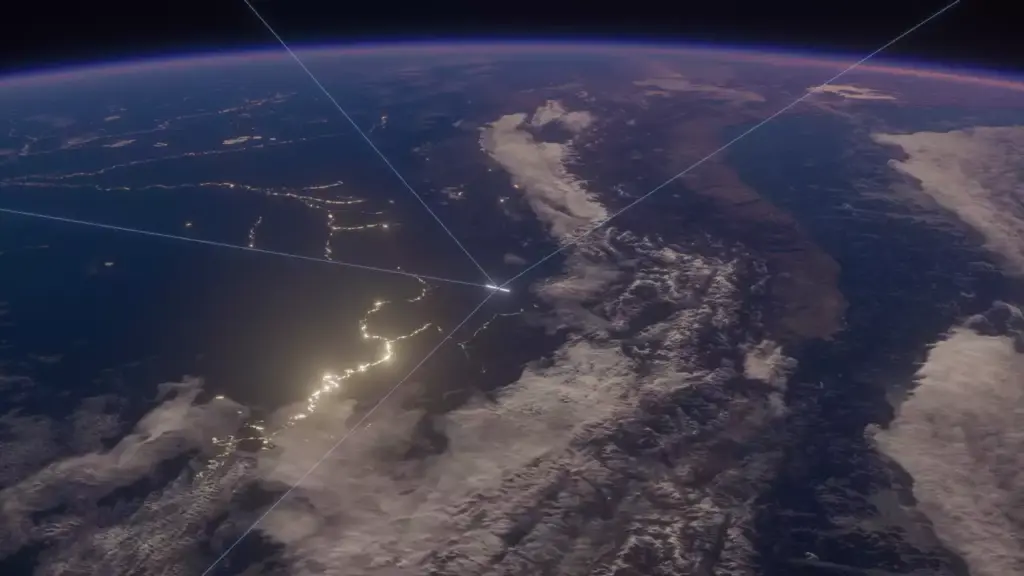
These optical links allow satellites to transfer data directly between one another, creating a high-bandwidth mesh network in orbit. Rather than relying entirely on a nearby ground station, traffic can travel across multiple satellites before reaching its destination. The additional links also provide greater redundancy, giving data more potential paths through the constellation.
With six 400 Gbps optical connections, V3 satellites can both move significantly more traffic through space and support increased communications capacities.
A massive backhaul upgrade
The connection between V3 and Starlink’s ground infrastructure has also received a major upgrade.
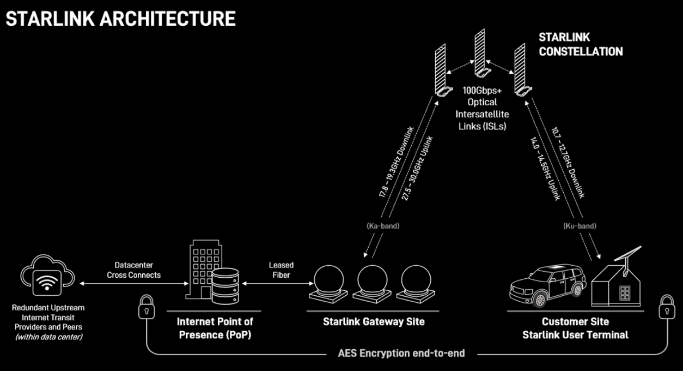
Each satellite features four quad-band RF (Radio Frequency) backhaul antennas supporting Ka, E, V and W bands. Together, these provide approximately 1.2 Tbps of RF backhaul capacity, more than eight times the supported capacity of the V2 generation. In comparison, V2 satellites only support Ka and E bands for backhaul frequencies.
The new antennas also support 60 GHz of spectrum across frequencies and polarizations for backhaul uplink, a 4.3 times increase over V2. This is an important part of the V3 architecture. Increasing the satellite’s capacity is only useful if the network can also move that additional data between the satellite and the ground.
SpaceX is upgrading the entire communications chain rather than simply increasing each satellite’s theoretical throughput.
Twice the power
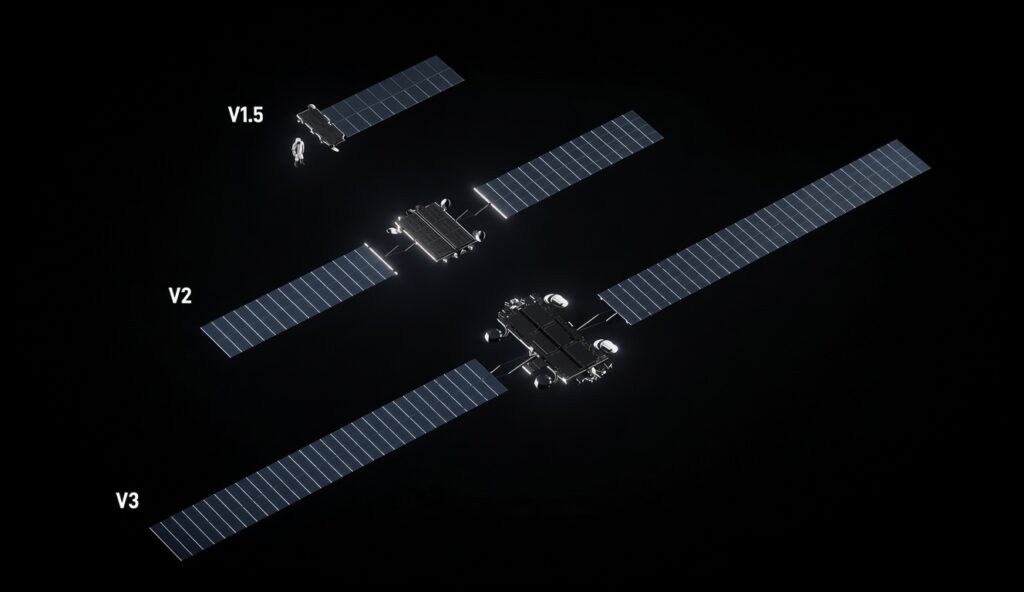
All of this additional hardware requires substantially more power. V3’s solar arrays are designed to generate approximately twice the power of those used on V2 satellites, providing the energy required by the satellite’s larger processing and communications systems.
SpaceX has also introduced new manufacturing techniques for the solar arrays. The company says it can produce the solar blanket as a continuous roll before segmenting and stitching sections together to form a complete array. The arrays are also optimized to reduce drag at the lower orbital altitudes where V3 satellites will operate.
The larger power system is therefore a fundamental part of the V3 design. Higher bandwidth, increased processing and additional networking hardware all require more electricity.
From test hardware to operational satellites
Starship IFT-13 provided the first in-space demonstration of the V3 platform.
The mission deployed 20 V3 satellites on a suborbital trajectory, allowing SpaceX to test the spacecraft and its deployment system ahead of operational missions. The satellites deployed their solar arrays, test-fired thrusters, and established RF and laser links, and returned telemetry for about 20 minutes before their planned re-entry.
IFT-14 is expected to take the next step by deploying operational V3 satellites into the Starlink constellation.
The next generation of Starlink
Starlink V3 is ultimately less about a single headline specification and more about the combination of upgrades across the entire spacecraft. Higher-bandwidth phased arrays, thousands of communication beams, six high-speed optical links, upgraded RF backhaul, increased processing capability and substantially more power all work together to create a significantly more capable satellite.
The result is a platform designed to provide more capacity per satellite, support more simultaneous users and move more data throughout the constellation.
SpaceX says each Starship launch carrying V3 satellites is expected to add around 60 Tbps of capacity to the Starlink network, more than 20 times the capacity added by a Falcon 9 launch of V2 satellites. As SpaceX begins deploying V3 at scale, these improvements should become realized as the Starlink network continues to grow.
V3 is not simply a larger Starlink satellite, but the next-gen platform to support SpaceX’s growing ambitions with its satellite network.