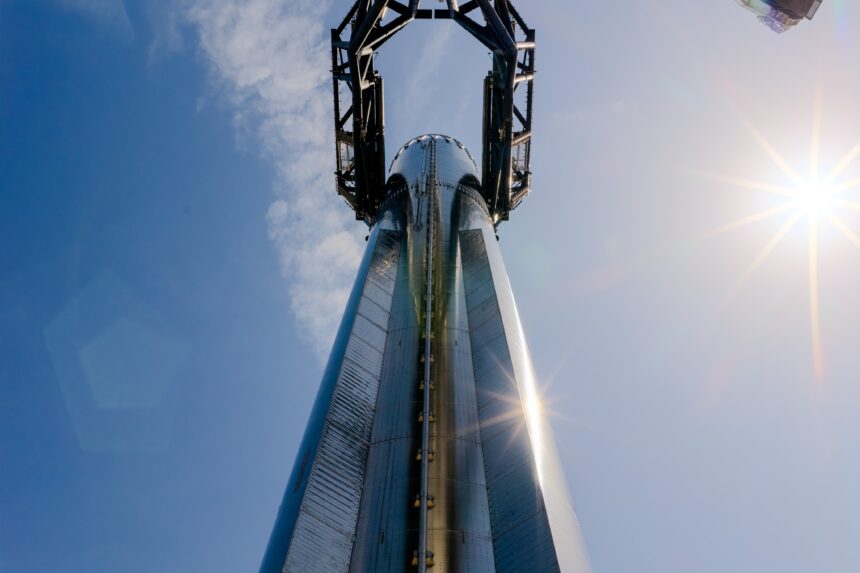
Starbase is running two Starship stacks in parallel: Booster 22 and Ship 42 are at Massey’s for cryogenic proof testing as the planned Flight 15 pairing, while Flight 14, with Booster 21 and Ship 41, is now targeted as early as Monday, 28 September 2026, pending regulatory approval.
That moves the company aim off the prior Tuesday, 22 September window. SpaceX posted the Monday-or-later retarget on 17 September, quoting its earlier Sep 22 target post. Next Spaceflight now opens Monday at 12:15 GMT through 13:30 GMT, and Spaceflight Now marks NET 28 September. The Flight 14 mission page may still show the older clock until it refreshes.
So the Starbase picture is still two live stacks at once: the next pairing (B22/S42) in cryo proof at Massey’s, and the near-term IFT-14 flight aimed as early as Monday’s open.
Flight 15 Cryo at Massey’s
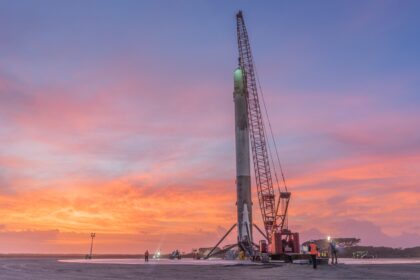
Booster 22 rolled from Mega Bay 1 to Massey’s for a multi-day cryogenic proof campaign, and Ship 42 joined it there for further cryo on a second trip after earlier ship-stand testing at the site, per NASASpaceflight coverage.
With cryo under way, the next hardware steps after Massey’s are already mapped. Booster 22 is expected back to Mega Bay 1 for Raptor install, then a Pad 2 static fire. Ship 42 still needs engines in Mega Bay 2 and its own static fire before the stack can climb toward a Flight 15 attempt. No Flight 15 launch date or payload is public, and that usually stays quiet until after Flight 14 flies.
Flight 14: First-Orbit Goals Still Stand
Flight 14 remains Booster 21 and Ship 41, both Starship-Super Heavy V3 hardware, on the near-term pad path from Starbase Pad 2. The last full public mission package still frames a first-orbital attempt: roughly 275 km altitude, about six orbits, an around-ten-hour mission, and a Pacific splashdown west of Chile after a deorbit burn.
The ship is still set to deploy 26 Starlink V3 satellites — about 1 Tbps each, or roughly 26 Tbps for the mission — while the booster aims for a Gulf landing rather than a tower catch. Heat-shield work from Flight 13 recovery carries into this stack, and three of the V3s fly with cameras for heat-shield imagery. SpaceX has not published a new slip reason, a revised FAA advisory, or a refreshed Sep 28 clock on the mission page in the same post that moved the target.
The final FAA launch license remains the gate. Until that lands, Monday’s “as early as” targeting can still slip even with SpaceX, Next Spaceflight, and Spaceflight Now pointing at 28 September.
15 Comes After 14
With Flight 15 expected roughly one month from whenever 14 launches, a lot still rides on B21 and S41. Catch-up work on Pad 2, the booster, the ship, or the tower can play into how quickly the next flight is cleared, or whether SpaceX has to rework V3 hardware after the first orbital try.
SpaceX has also filed a communications authorization application for Flight 15 that requests an operating window from 28 September 2026 through 28 March 2027. That filing is not yet granted and may be amended, but it points to SpaceX wanting a faster cadence once Flight 14 is behind them.
Until cryo wraps, Booster 22 and Ship 42 still need engines and static fires after Massey’s. Flight 14 is now aimed as early as Monday, 28 September, pending approval — and the next step after that target is either fly or slip again.