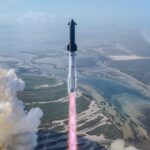
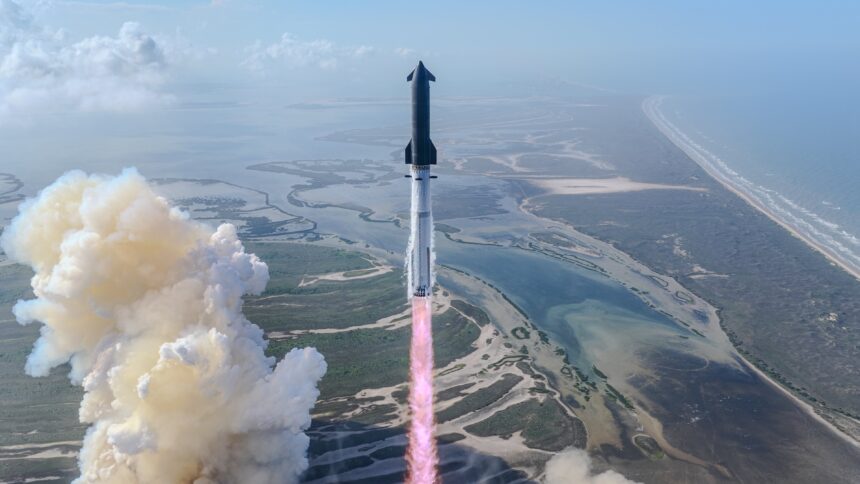
SpaceX’s Starship reached sustained orbit for the first time on Monday, 28 September 2026, and then spent the morning proving it could complete its first mission. Integrated Flight Test 14 / Starlink Group 31-1 left Starbase Pad 2 at 12:48:59 GMT (8:48 a.m. EDT / 7:48 a.m. CT) with Booster 21 under Ship 41.
Ship 41 was also carrying 26 Starlink V3 satellites, the first launch of the new hardware, and the first proper mission for Starship itself, all in one go.
What follows is how that flight actually went. We’ll look at liftoff, staging, booster splashdown, as well as some more unexpected events, like an unexpected RVac cut that nearly cancelled the orbit call, followed by the deployment of the Starlink V3s and then splashdown in the Pacific.
Liftoff and Staging From Pad 2
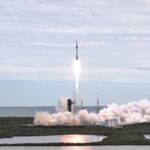
Liftoff yesterday was one of the cleanest that Starship and Super Heavy Booster have had to date. All 33 raptors on Super Heavy lit for the climb off Pad 2 with no issues at the start. One booster engine did end up dropping out about two minutes up, but it wasn’t enough to impact flight operations. Super Heavy Booster is built with a level of redundancy, enabling it to continue even with a couple engines out.
LAUNCH! Starship Flight 14 launches from Starbase Pad 2 on its first orbital mission attempt.
Live on X and YT:
https://t.co/qFSXNsNURapic.twitter.com/YcZoz3Rndr
— NSF – NASASpaceflight.com (@NASASpaceflight) September 28, 2026Hot staging a few minutes later then put Ship 41 on its own path, while Super Heavy did its flip and began to return to Earth. Just like the last few attempts, this hot stage was clean.
Staging 1-2. pic.twitter.com/Zcis3TABJ1
— NSF – NASASpaceflight.com (@NASASpaceflight) September 28, 2026Booster 21 to the Gulf
Booster 21 came back for a controlled Gulf of Mexico splashdown about seven minutes after liftoff. This was part of the planned schedule for this flight, as no tower catch was planned here. Booster 21 landed relatively softly in the Gulf and exploded a few minutes later when it began to collapse from its own weight.
Booster 21 lands! pic.twitter.com/1PgY1R6LPC
— NSF – NASASpaceflight.com (@NASASpaceflight) September 28, 2026One RVac Out — Then Go, No-Go, Go
Ship’s ascent came with a lot of drama this time. Roughly seven minutes after liftoff, one of Ship’s six Raptors, an RVac, the vacuum-optimized engine, shut down early. The other five burned longer than planned to smoothly slide Ship into its initial suborbital arc.
At SECO (secondary engine cut-off), the question became whether SpaceX would still chase orbit or call off the second half of the mission.
Ship 41 SECO. Had lost one RVac, so we'll see what they decide for the orbital element. pic.twitter.com/qUVsPY5RsV
— NSF – NASASpaceflight.com (@NASASpaceflight) September 28, 2026On SpaceX’s livestream, communicator Dan Huot first waved off the insertion burn. “We’re only going to commit to orbit if everything is looking really healthy,” he said. “Because of that, we are not going to do the additional burn that would send us into orbit.”
“We are not giving up yet… We will continue to hang out.”
Then the room flipped. “Actually, stand by,” Huot came back, after “a lot of conversation in the room behind me.” A fresh go/no-go poll closed the other way: “The go/no-go poll for orbit has finished, and we are go for orbit.”
Starship Flight 14: GO for orbit. pic.twitter.com/gqM96eJsBe
— NSF – NASASpaceflight.com (@NASASpaceflight) September 28, 2026Around T+25 minutes, Ship fired a single Raptor for about 19 seconds, and made history for the Starship program.
“Starship is orbital.”
Altitude landed in the ~173 mile / ~275 km class SpaceX had originally planned in the pre-flight. That means that Starship has finally hit one of its largest milestones, a complete sustained orbit, after what was nearly a mid-flight scrub.
Starship is orbital! pic.twitter.com/6J5kkKXuSM
— NSF – NASASpaceflight.com (@NASASpaceflight) September 28, 2026All 26 Starlink V3 Out
Payload deploy opened around T+34 minutes. By about 9:53 a.m. ET, all 26 Starlink V3 satellites were out. Three of them also carried cameras to help image Ship’s heat shield, as well as the deployment of some of the other satellites. SpaceX later confirmed that the Starlink team had made contact with the full set of 26 satellites.
Starship Flight 14: Starlinks are deploying. pic.twitter.com/nc1iymhMvp
— NSF – NASASpaceflight.com (@NASASpaceflight) September 28, 2026Flight 13 had previously lofted V3s on a suborbital path, but this Flight 14 successfully inserted them into an operational orbit.
Three Hours Instead of Ten
Pre-flight, SpaceX had sketched roughly ten hours, about six orbits, and a Chile-area Pacific splashdown. After the ascent engine issue and health checks, the team cut that to about three hours and deorbited into a pre-cleared northern Pacific zone.
Starship Flight 14: Ship 41 Deorbit Burn.
Good burn. Nice TVC action too. pic.twitter.com/TCrRteUief
— NSF – NASASpaceflight.com (@NASASpaceflight) September 28, 2026Ship hit entry exactly as planned, then bellyflopped, flipped, and burned for a splashdown around T+3 hours 8 minutes.
Starship Flight 14: Ship 41 entry interface and into peak heating regime.
The fact that we're watching this live is crazy in itself (the size of the vehicle and the Starlink downlink). pic.twitter.com/lcQztEVHqY
— NSF – NASASpaceflight.com (@NASASpaceflight) September 28, 2026It hit the water intact, then toppled and exploded, so no tow-recovery this time.
Starship Flight 14 Concludes! Ship 41 bellyflop, flip-and-burn, and splashdown (and this time, the expected explosion)!
Full stream from T-4 hours on X and YT:
https://t.co/qFSXNsNURapic.twitter.com/zFGugrFFrA
— NSF – NASASpaceflight.com (@NASASpaceflight) September 28, 2026What Monday Proved — And What It Didn’t
SpaceX has finally put to rest the allegations that Starship would never make orbit and never achieve mission success. It can finally put up larger satellites than Falcon 9 and Falcon Heavy could, and that alone is a great first success and a milestone for the program.
Each Starlink V3 provides near 1 Tbps of bandwidth, with the batch bringing 26 Tbps online. That’s nearly as much bandwidth in one single launch as goes up in Falcon 9 in 18 months, and Starship wasn’t even fully loaded yet.
What Flight 14 didn’t prove is that Starship is reusable. We’ll still need to see a Ship and Booster catch at the same time, and have it done enough times that it becomes a repeatable, normal process. Once that’s done, orbital refueling and HLS/Artemis flight testing remain key steps forward for the Starship program.