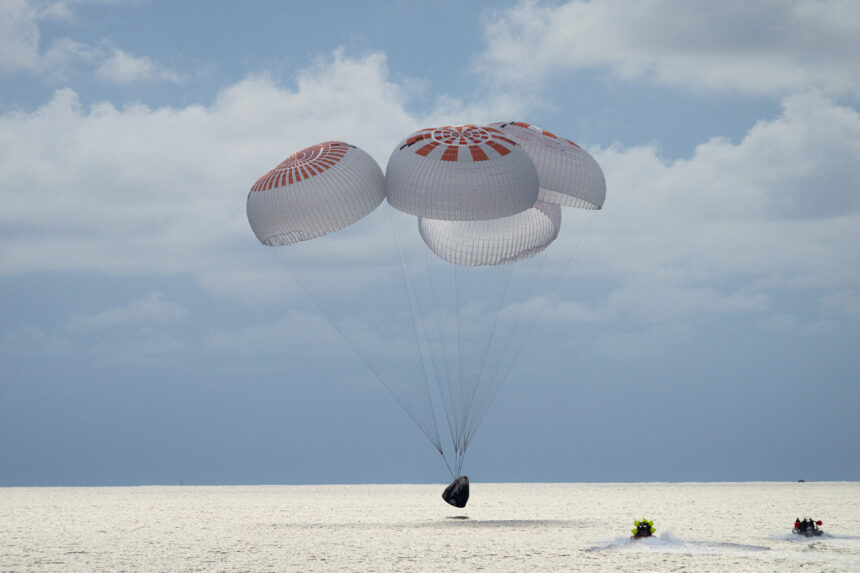
SpaceX’s Crew Dragon Freedom splashed down in the Pacific Ocean off the coast of Los Angeles at 11:34 a.m. ET on Thursday, Oct. 8, ending NASA’s Crew-12 mission after 237 days aboard the International Space Station.
Splashdown of Dragon confirmed! pic.twitter.com/P2o7A3Gytf
— SpaceX (@SpaceX) October 8, 2026NASA astronauts Jessica Meir and Jack Hathaway, ESA astronaut Sophie Adenot, and Roscosmos cosmonaut Andrey Fedyaev were aboard. They returned at 8:34 a.m. Pacific time. Teams on SpaceX recovery vessels retrieved the spacecraft and its crew shortly after, and the crew will fly to shore, then to NASA’s Johnson Space Center in Houston, after standard postflight medical screenings.
Clean Return Flight
Crew Dragon Freedom undocked at 8:05 a.m. ET on Wednesday, Oct. 7, from the space-facing port of the station’s Harmony module. The undocking had been set for no earlier than that morning, due to previous weather delays. Dragon completed its deorbit burn as planned ahead of splashdown. NASA says the drogue parachutes deployed about four minutes before splashdown, at about 18,000 feet and roughly 350 mph, with the main parachutes following at about 6,000 feet and roughly 120 mph.
They're back! Crew-12 splashed down off the coast of California at 11:34am ET (1534 CT), wrapping up their mission of scientific exploration and discovery.
Stay tuned for continuing live coverage as Crew-12 and their SpaceX Dragon spacecraft are retrieved from the Pacific. pic.twitter.com/aSQqR3mLj5
— NASA (@NASA) October 8, 2026237 Days, Four Spacewalks
In 237 days the four crew members traveled more than 100 million miles and completed more than 3,792 orbits of Earth. It was the second spaceflight for Meir and Fedyaev, and the first for Hathaway and Adenot.
The mission included four spacewalks. Meir completed all four, bringing her career total to seven, third all-time among women at NASA, behind former NASA astronauts Peggy Whitson and Suni Williams. Adenot completed three and became the first French woman to go outside the station.
What the Crew Worked On
NASA says the crew logged hundreds of hours of research aimed at exploration beyond low Earth orbit and at uses on the ground. The work included testing stem cell production for cell-based therapies, demonstrating on-demand generation of IV fluid for future missions, and studying how the bacteria that cause pneumonia can lead to long-term heart damage.
Jessica, Jack, Sophie, and Andrey spent 237 days living and working in orbit, traveled more than 100 million miles, advanced important science, and returned safely home because of the extraordinary expertise and competence of thousands across NASA, SpaceX, and our international partners.
Jared Isaacman, NASA Administrator
The crew also ran nutrition research and looked at how physical characteristics may affect blood flow during spaceflight, which NASA ties to keeping astronauts safe on later missions.
NASA’s activities supporting the International Space Station — transporting crew, conducting impactful research, and maintaining critical national assets — enable the science, engineering, and risk-reduction needed for future missions across the solar system. We’re grateful for the dedication across the human spaceflight team that makes this possible, and we’re thrilled to welcome Jessica, Jack, Sophie, and Andrey home.
Dana Weigel, manager, NASA’s Low Earth Orbit Program
The Oct. 15 Briefing
Meir, Hathaway, and Fedyaev will discuss the mission at a news conference at 3:30 p.m. ET on Thursday, Oct. 15, at Johnson Space Center. Adenot is returning to Europe and will not attend.
Crew-13 launched while Crew-12 was still aboard and docked to the station. Crew-13 remains there now.





![Falcon 9 to Launch SDA Tranche 1 Transport Layer A [Scrubbed]](https://thegridfin.com/wp-content/uploads/2026/07/SpaceX_SLC_4E_01-150x150.jpg)