
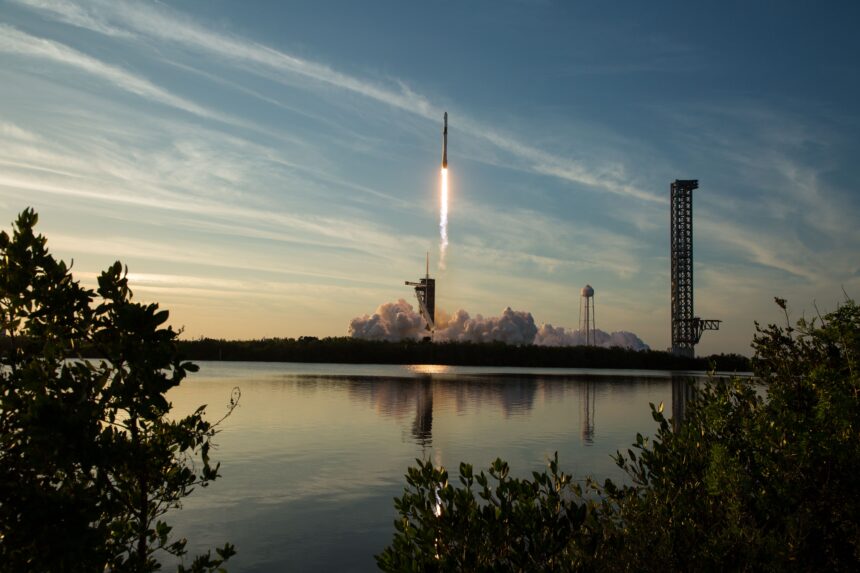
Elon Musk has confirmed with a post on X that SpaceX’s workhorse rocket, the Falcon 9, which currently hauls the majority of mass to orbit, will eventually be sunset. But that sunset won’t be immediate.
The Weekly-to-Daily Trigger
Musk’s confirmation that Falcon will eventually be sunset isn’t surprising, as SpaceX’s stated goal with Starship is to eventually have the large-scale reusable rocket do all Earth-to-Orbit and beyond lift tasks. But this isn’t an immediate retirement plan, and Falcon won’t disappear overnight.
Instead, once SpaceX can finally prove Starship‘ and Super Heavy‘s reusability, and ships are going to orbit several times a week, we’ll begin to see the retirement of Falcon. Falcon is the rocket that made space accessible and affordable, but Starship will be even cheaper, and eventually fly with an even higher cadence.
The end goal is to get Starship launches happening several times a day, which will require a lot of focus.
Consolidating Resources
Musk’s logic is that the engineers, factories, launch teams, sites, and suppliers are all currently split across two families of rockets. Eventually, to enable rapid reusability of Starship, all of these scarce resources will need to be focused on just Starship.
For now, while Starship is still in development, the split makes sense and enables SpaceX to continue commercial and government payloads, as well as Starlink launches. But once Starship is ready, any payload that can fit in Falcon can comfortably fit in Starship, and alongside a full load, will likely be cheaper, faster, and just as reliable as a Falcon launch.
What Falcon Still Supports
However, Falcon is still SpaceX’s workhorse rocket. It launches commercial and government payloads to orbit, along with trips to expand the Starlink constellation on a weekly basis. Falcon 9 and Crew Dragon currently provide NASA’s only operational U.S.-launched route for astronauts to the ISS
Plus, Falcon Heavy also provides support to missions that can’t migrate without additional integration and certification work, like national-security focused payloads. The transition away from Falcon to Starship will need to be well communicated with SpaceX’s commercial and government partners to ensure they can certify Starship for their payloads.
Dragon vs Starship
The central question is whether the Crew and Cargo Dragon will keep on functioning with a dedicated Falcon line, or whether SpaceX will push NASA to certify Starship for docking. Ars Technica‘s Eric Berger conducted a detailed analysis on the industry’s potential reaction to Crew Dragon being cancelled in the early 2030s, and with the ISS slated for retirement around the same time, things may just pan out as SpaceX wishes.
NASA is partnering with private companies to develop space stations, and the other major launch providers, including Boeing, likely won’t fly another crewed mission for quite some years to come. Other industry officials are concerned about the ability to reliably fly both crews and suppliers to orbit for their own stations.
Either way, for the near future, Falcon 9 will keep up its high launch cadence until Starship can fully replace it.






![Falcon 9 to Launch SDA Tranche 1 Transport Layer A [Scrubbed]](https://thegridfin.com/wp-content/uploads/2026/07/SpaceX_SLC_4E_01-420x280.jpg)