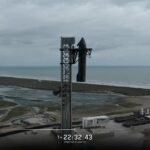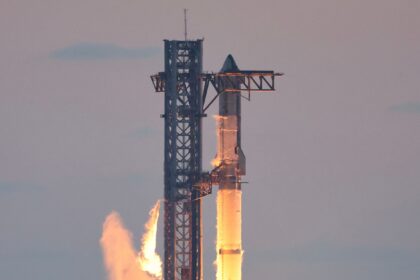
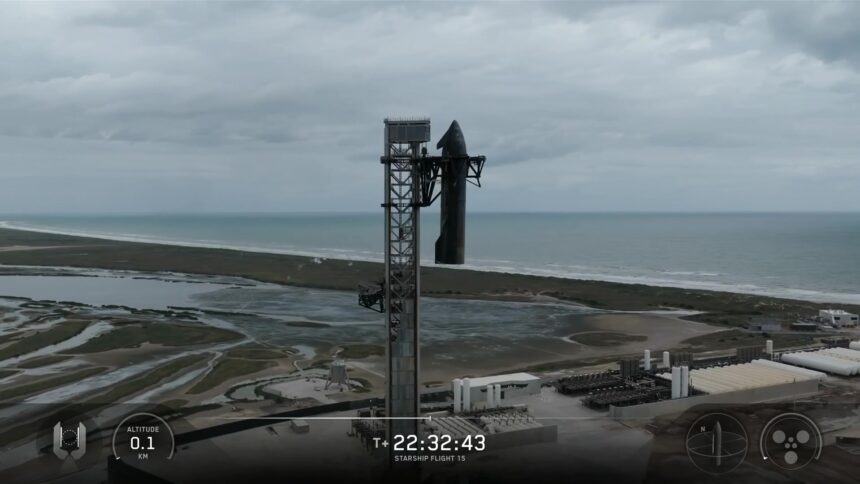
It was a milestone week for SpaceX this week, and for human spaceflight in general. SpaceX finally caught Starship, the upper stage, for the first time in the tower chopsticks at Starbase. Mechazilla‘s tower arms closed around ship and it throttled down safely.
While the Super Heavy self-aborted due to what Elon noted as “low fuel”, the mission was still an overall success. The 26 Starlink V3 satellites that ship took to space have been successfully inserted into orbit.
Mechazilla catches Starship! Congratulations to the entire SpaceX team on this incredible achievement! pic.twitter.com/YJzmGUZb2B
— SpaceX (@SpaceX) November 14, 2026Flight 15: Ship Caught, Booster Lost
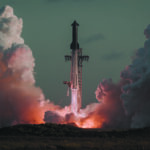
Flight 15 lifted off from Pad 2 at Starbase on Friday, Nov. 13, at 5:47 p.m. ET. It was planned as the first flight to catch both stages at the tower. After hot-staging, Super Heavy began boosting back toward Starbase, then, at 5:55 p.m. ET, SpaceX said it had “diverted to an offshore splashdown in the Gulf.” It was the first catch attempt for a Super Heavy V3; three earlier V1 boosters had been caught.
Liftoff of Starship! pic.twitter.com/lc7UtE6H7z
— SpaceX (@SpaceX) November 13, 2026SpaceX’s Dan Huot said on the webcast that guidance triggered an automatic abort because the booster “was not in the place that it was supposed to be to proceed with a catch.” The company’s mission page later said the boostback burn ended early due to low fuel mass, with the root cause under investigation, and that the flight termination system was triggered after the landing burn over the Gulf. Elon Musk’s own explanation was that the “booster was slightly low on fuel,” and that losing the tower “would potentially cost us 2 to 3 months.”
Super Heavy has diverted to an offshore splashdown in the Gulf pic.twitter.com/1M2xn7NYJA
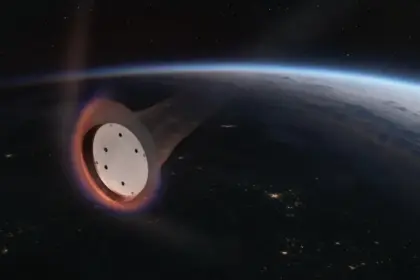
— SpaceX (@SpaceX) November 13, 2026While the booster turned out to sea, the ship reached a roughly 275 km orbit and deployed its payload. “Payload deploy complete. All 26 @Starlink V3 satellites are in orbit,” SpaceX said at 7:06 p.m. ET. The mission page says each V3 adds 1 terabit of capacity, and that the 26 equal about 10 Starlink V2 Mini launches on Falcon 9. After more than 20 hours in orbit, and after SpaceX called the heatshield, pad and tower “go,” Ship 42 reentered and was caught.
On the webcast, Huot said: “We caught a Starship, and now everything changes.” Musk later posted, “Ship 42 looks great!”
$74 Billion for Two Supercompute Campuses
On Nov. 12, SpaceX said two supercompute campuses — more than $24 billion at Starbase and a roughly $50 billion site in Cochise County, Arizona — represent more than $74 billion in planned American investment. The company says the sites will train its frontier intelligence systems. The Arizona campus, SpaceX says, will have no gas turbines and no on-site power plant, with about 5,500 construction jobs at peak and 1,000 permanent jobs. In Texas, SpaceX has committed $220 million to expand water and wastewater infrastructure for Brownsville and Cameron County.
Boca Chica Land Talks
In a Nov. 13 Updates post, “Restoring Boca Chica Beach,” SpaceX said it has “discussed the potential purchase of approximately 1,200 acres” of Texas Parks and Wildlife Department land around the launch site, and that about 600 acres would go under a permanent conservation easement. It said Boca Chica Beach is not part of the proposed sale and “is, and will remain, public.” The stated reason is that people have been reaching operational areas through park land without authorization.
Also This Week
The FCC accepted SpaceX’s applications to acquire Grain Management’s 800 MHz licences for filing (DA 26-1218, Nov. 10). Comments and petitions to deny are due Dec. 1; acceptance is not approval. SINGULUS TECHNOLOGIES said SpaceX ordered a turnkey heterojunction solar-cell line for the Bastrop, Texas, factory, with the first line valued at more than €60 million and due in the first half of 2027, to support Starmind satellite production.
At last week’s UP.Summit, SpaceX vice president of launch Kiko Dontchev told Ars Technica that “we are a rocket company, but fundamentally we are an infrastructure company at this point,” and that Falcon 9 still throws its second stage away every flight. He said pad 39A at Kennedy is “effectively complete,” with the first barge transports of boosters and ships to the Cape hoped for in December.
A Falcon 9 also launched USSF-627 from Vandenberg on Nov. 11 at 11:36 p.m. ET and landed on Of Course I Still Love You. Bloomberg reported that SpaceX–Tesla merger talks are progressing, with a deal possibly announced as soon as December.
Coming Up
FCC comments on the Grain transfer are due Dec. 1. Hearings on the Cochise County and Starbase projects are set for Dec. 9.
Previously: This Week in SpaceX, Nov. 1.