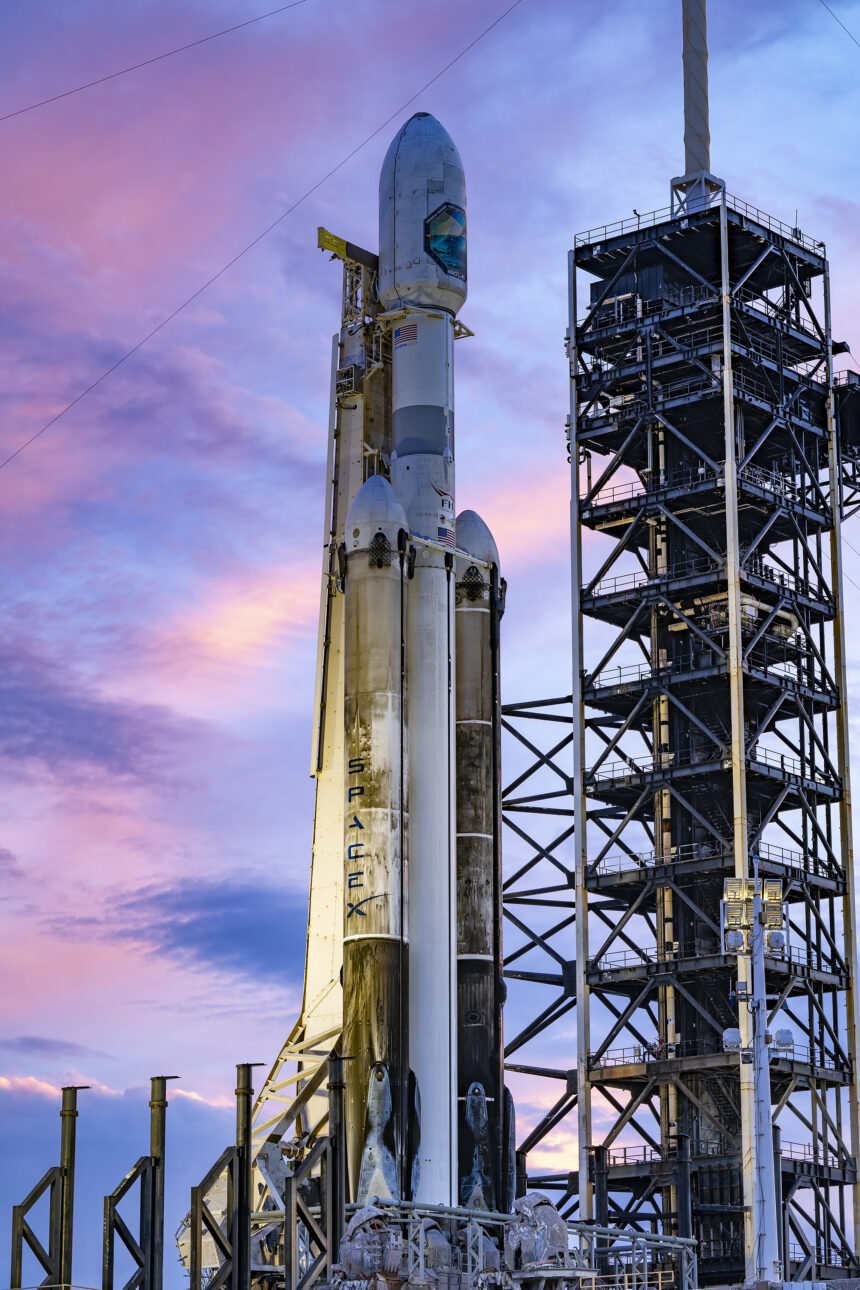
While SpaceX really doesn’t like flying the Falcon Heavy, there are still some payloads that are large enough or require enough energy that there isn’t another choice. In this case, NROL-97 lifted off on a Falcon Heavy from Launch Complex 39A at Kennedy Space Center at 11:54 p.m. EDT on Thursday, Oct. 1 (3:54 a.m. GMT on Oct. 2),
NROL-97 is a classified mission from the National Reconnaissance Office, the United States’ reconnaissance satellite agency. NROL-97 is Falcon Heavy’s 14th flight to date, and the first time the NRO has flown a payload on this rocket.
The mission resulted in what is expected to be a orbital insertion into a high-energy orbit, and both side boosters returned to Landing Zone 1 and Landing Zone 2 at Cape Canaveral Space Force Station. As usual with Falcon Heavy, the centre core was expended.
Falcon Heavy lifts off from pad 39A in Florida for the 14th time! pic.twitter.com/uuZLKNTdD7
— SpaceX (@SpaceX) October 2, 2026The NRO’s First Falcon Heavy
SpaceX said the mission was the NRO’s first launch aboard Falcon Heavy, after Falcon 9 had flown 22 missions for the office over nine years. Falcon Heavy flies as three Falcon 9 boosters under a single upper stage.
All of the NRO’s previous launches used just a single Falcon 9, and didn’t result in any core expenditures like this particular mission. Just like most NRO missions, this payload was classified, but it was delivered to a high-energy orbit. No altitude, inclination, or orbital elements have been published. SpaceX and the NRO have not said whether the upper stage restarted or whether the satellite separated.
Boosters, Fairings, and Centre Core
Both side boosters returned to the Cape. SpaceX’s mission timeline puts the landings at 7 minutes and 47 seconds after liftoff. SpaceX said one side booster was on its second flight (B1104) and the other on its fourth (B1072), after earlier launches of GOES-U, Viasat-3 F3, and NASA’s Nancy Grace Roman Space Telescope.
Falcon Heavy’s side boosters land on LZ-1 and LZ-2 pic.twitter.com/dBPcNeggFx
— SpaceX (@SpaceX) October 2, 2026The booster that landed on LZ1 was B1104, and on LZ2 was B1072. Interestingly, B1104 and B1072 flew together on Falcon Heavy just recently for the launch of the Nancy Grace Roman Space Telescope on August 30th. According to public-source trackers, this is the quickest turnaround between Falcon Heavy missions to date.
The centre core, B1106, was brand new, and had its first and final flight today, and was expended in orbit due to the payload mass. This is a common practice with Falcon Heavy when the additional performance is needed to place the satellite into a high-energy trajectory, and one of the reasons why Falcon Heavy launches are so much more expensive than Falcon 9.
NROL-97 also was one utilized repurposed payload fairings from NROL-95’s launch on July 30th, making this one of the most part-efficient launches to date.
Phase 3 Lane 2
NROL-97 is the first NRO mission to fly after the procurement of the National Security Space Launch Phase 3 Lane 2 contract in 2025. The program procured several SpaceX flights, on both Falcon 9 and Falcon Heavy hardware, to bring NRO assets to orbit.





![Falcon 9 to Launch SDA Tranche 1 Transport Layer A [Scrubbed]](https://thegridfin.com/wp-content/uploads/2026/07/SpaceX_SLC_4E_01-150x150.jpg)