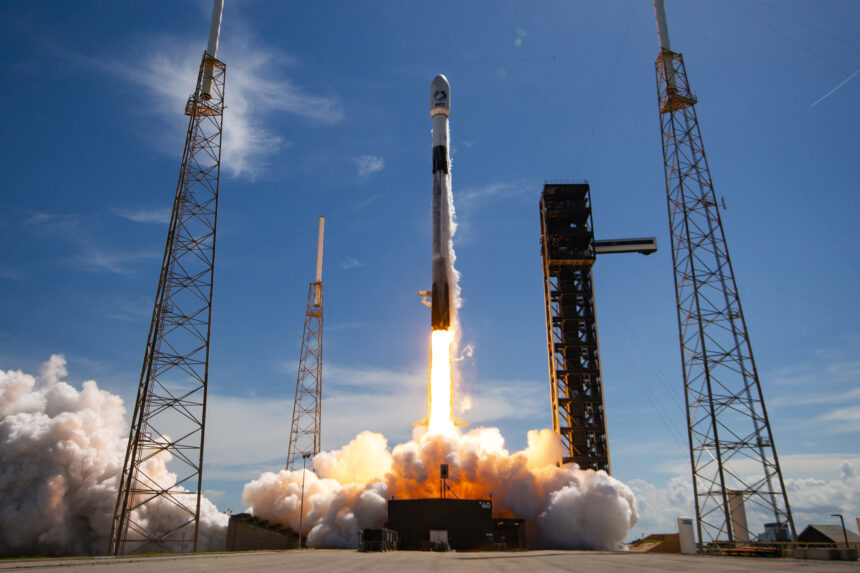
A Falcon 9 launched SpaceX’s 35th Commercial Resupply Services mission (CRS-35) for NASA at 6:33 a.m. ET on Tuesday, Oct. 13, 2026, from Space Launch Complex 40 at Cape Canaveral Space Force Station. Cargo Dragon is carrying more than 6,300 lb of supplies, science and hardware to the International Space Station, including the last pair of new solar arrays the station needs to finish its power upgrade.
Liftoff! pic.twitter.com/0naEicD1Dl
— SpaceX (@SpaceX) October 13, 2026Booster Back at the Cape
The first stage came back to Landing Zone 40, next to the pad, less than 7.5 minutes after liftoff, with a sonic boom rolling over the coast. According to Spaceflight Now, it was booster B1096 on its eighth flight, after KF-01, IMAP, NROL-77, GPS III-9, CRS-34, NROL-95 and a Starlink mission.
Falcon 9 lands on Landing Zone 40 pic.twitter.com/WbkYBCZ0Ha
— SpaceX (@SpaceX) October 13, 2026Dragon separated from the upper stage about two minutes later. Spaceflight Now identified the capsule as C211, flying for the fourth time after CRS-26, CRS-29 and CRS-33.
The Last Solar Array Pair
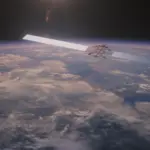
The headline cargo rides in Dragon’s unpressurized trunk: the fourth and final pair of International Space Station Roll-Out Solar Arrays, or iROSA, built by Redwire Space. Each array produces more than 20 kW and is designed to last more than 10 years, according to Spaceflight Now. NASA says they complete the station’s power upgrade, adding electricity for research, day-to-day operations and the station’s eventual controlled deorbit. Astronauts will install them during spacewalks planned for later this fall. NASA has not set the spacewalk dates.
The roll-out design was first tested on the station in 2017, when a demonstration array flew up on CRS-11.
It’s been quite the journey. Folks may remember back in 2017 when we launched the ROSA on CRS-11 and that’s really where we demonstrated this innovative approach to deploying a solar array.
Gaurang Patel, NASA Low Earth Orbit Program operations integration manager
Science on Board
Among the new experiments in the NASA manifest:
- Hardware to manufacture artificial retinas in microgravity, which could help restore vision for patients on Earth.
- 3D heart tissue models to advance large-scale drug testing on future missions.
- Materials to study how a new type of glass forms in microgravity.
- Brain organoids that could reveal treatment targets for Alzheimer’s, Parkinson’s and multiple sclerosis.
The glass study is the most unusual of the four.
These unconventional glasses could have remarkable properties, including refractive indices higher than diamond, greater resistance to breaking, and even the ability to contract rather than expand when heated.
Dr. Liz Warren, NASA ISS Office deputy chief scientist
Docking Thursday
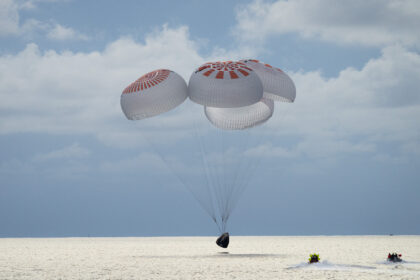
Dragon is set to dock on its own to the space-facing port of the Harmony module at about 11 a.m. ET on Thursday, Oct. 15. NASA’s rendezvous and docking coverage starts at 9:15 a.m. ET. The capsule is scheduled to stay until mid-November, then return to Earth with time-critical research and cargo and splash down off the coast of California. Our Dragon explainer has more on the spacecraft.