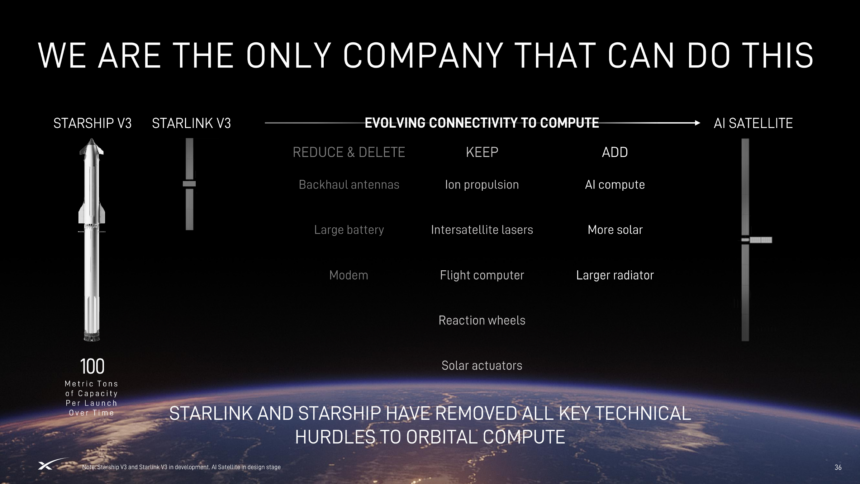
Starmind is SpaceX’s plan to put AI computing in orbit: satellites that run AI workloads on solar power, shed heat into space and send their results back to Earth over Starlink’s laser network.
While it isn’t in orbit quite yet, there has been a lot of discussion on the topic to date, especially with TERAFAB, the site intended to eventually make the compute destined for orbit, beginning construction soon.
This week, a Morgan Stanley note gave the idea behind it a name investors may start hearing a lot: the Distributed Inference Cloud.
The Morgan Stanley Note
In a new note on SpaceX, Morgan Stanley analyst Adam Jonas called the Distributed Inference Cloud the most overlooked part of the company’s story.
The part of the SpaceX story that we believe holds the greatest growth potential, and that is being largely ignored/not contemplated by investors, is the Distributed Inference Cloud. Investors are already witnessing some degree of corporate/regulatory/social angst toward data centers.
Adam Jonas, Morgan Stanley
Jonas’s version is built from robots and connected devices on the ground, all linked through Starlink. The note estimates about 2.2 billion robots of all types by 2040. At roughly 500 watts of compute each, that adds up to about 1.1 terawatts, more than the roughly 380 gigawatts Morgan Stanley models for SpaceX’s own compute in 2040.
“As the ‘density’ of physical agents increases, we expect incrementally greater intelligence capability of the collective mobile swarm,” the note says. It asks investors “to be prepared to hear about the Distributed Inference Cloud and physical AI swarms in the coming year.”
Elon Musk quoted the excerpt and replied: “True, this is a very big deal.”
Starmind Is the Same Idea, Moved to Orbit
The note is about robots, but the same logic carries straight up into orbit. Distributed inference means running AI where power and connectivity already are, instead of piling it into one giant data centre that has to fight for grid power, water and permits. A robot swarm does that on the ground. Starmind does it in space, where the power source is the Sun and the cooling is free.
Both depend on Starlink as the network that ties scattered compute together. Both are a way around the “angst toward data centers” the note describes. And both turn SpaceX’s strength, building and flying huge numbers of identical machines, into compute capacity.
If the Distributed Inference Cloud is the swarm at street level, Starmind is the layer above it.
What a Starmind Satellite Is
SpaceX calls the first satellite AI1. Its Starmind page describes it as an orbital satellite with local compute that uses the power and cooling available in space and beams data back through high-bandwidth lasers to the Starlink constellation. The page lists:
- Deployed height: 30 m (98 ft)
- Wingspan: 75 m (246 ft)
- Compute payload: up to 250 kW peak, 175 kW average
- Vehicle efficiency: 75 kW per tonne
SpaceX says the satellites use proven technology and are more streamlined than the Starlink satellites it already builds at scale. The design is modular and chip-vendor agnostic, so compute modules from any supplier can slot in.
Why Put Compute in Space
SpaceX makes three arguments.
Power. In sun-synchronous orbit, AI1 satellites capture continuous solar power. There is no weather, no atmosphere absorbing light and no grid connection to wait for.
Cooling. Ground data centres spend a large share of their power on chillers, cooling towers and fans. In orbit, heat radiates into the vacuum. SpaceX says that cuts cooling power overhead by an order of magnitude.
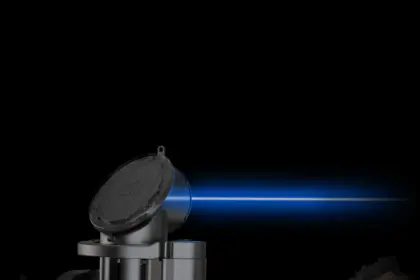
Connectivity. Laser links connect the satellites to each other and pass results down through Starlink. That is the same optical mesh covered in our explainer on how Starlink’s laser links work, and it is what turns a scattered fleet into one network instead of a million separate computers.
The Million-Satellite Filing
On Jan. 30, 2026, SpaceX asked the FCC for authority to launch and operate up to one million satellites as the “SpaceX Orbital Data Center system.” The satellites would fly in shells up to 50 km thick between 500 km and 2,000 km altitude, at 30-degree and sun-synchronous inclinations, relying on optical inter-satellite links. SpaceX described the system as a “first step towards becoming a Kardashev II-level civilization – one that can harness the Sun’s full power.”
The FCC’s Space Bureau accepted the application for filing on Feb. 4 and opened it for public comment. Comments were due March 6. Acceptance is a procedural step, not a licence. One million is the ceiling SpaceX asked for, not a build plan with dates. SpaceX says it is prioritizing safety and long-term orbital sustainability as its AI satellite constellation grows.
How SpaceX Plans to Build It
Starmind leans on three other SpaceX projects. The first is launch: SpaceX says Starship’s fully reusable design and payload capacity are critical for putting large, heavy AI satellites into orbit. The second is a factory. SpaceX is building the Gigasat Factory in Bastrop, Texas, and says it is planned to enable production and deployment of thousands of AI satellites starting as soon as late 2027.
The third is chips. SpaceX plans to make advanced AI chips at scale at TERAFAB, a fab it is building jointly with Tesla, using a modular architecture meant to let newer processors drop in over time.