Most payloads that leave a SpaceX pad fit on Falcon 9. Falcon Heavy exists for the heavier jobs that need to bring more mass up, move that mass with more energy, or put something straight into a geosynchronous orbit.
Starship is designed to replace Falcon 9 and Falcon Heavy entirely in the future, being cheaper, just as reusable, and lifting even more mass to orbit than either could do in a single run.
Falcon 9 As The Workhorse Envelope
SpaceX publishes Falcon 9’s maximum capability on a fully expendable flight as 22,800 kg to low Earth orbit, 8,300 kg to a geostationary transfer orbit, and 4,020 kg toward Mars. Those are the ceiling numbers on the Falcon 9 vehicle page, and close to expected performance that SpaceX guarantees its customers.
Recovering the booster costs performance, which is the trade most commercial customers accept: a reusable Falcon 9 list price of about $74 million through 2026 covers up to roughly 5.5 tonnes to a standard GTO.
That envelope covers almost everything SpaceX flies week to week. Crew Dragon and Cargo Dragon fly only on Falcon 9. Starlink rides Falcon 9. The vast majority of commercial GEO satellites that need a GTO drop, rideshares, and national-security LEO missions do too.
SpaceX has never human-rated Falcon Heavy, and it never puts Crew Dragon or Cargo Dragon on the triple-core stack, as there has never been a need.
The practical ceiling is not only mass. It is also how much propellant the first stage must hold back for its own boostback and landing burns. A customer who needs more mass to GTO, a higher characteristic energy for deep space, or a direct insert into geosynchronous orbit is the customer who starts looking at three cores instead of one.
What Falcon Heavy Adds
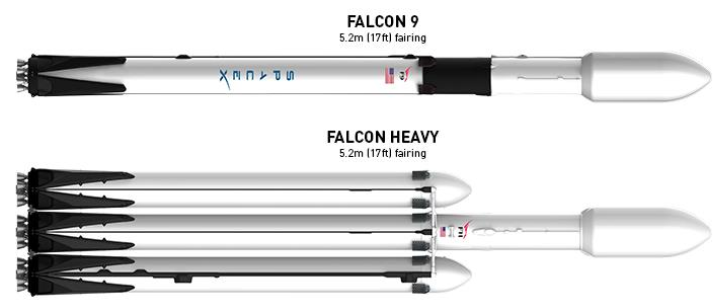
Falcon Heavy straps two additional Falcon 9 first stages beside a strengthened centre core. Twenty-seven Merlin engines light at liftoff and produce more than 5 million pounds of thrust.
That’s roughly equivalent to eighteen 747s at full power, in a stack that’s the same height as Falcon 9 (70m), but just three times as wide. That makes it relatively compact, at least for the short distance it needs to move between the vehicle assembly and pad.
Falcon Heavy’s expended performance jumps to 63,800 kg to LEO, 26,700 kg to GTO, and 16,800 kg toward Mars.
Reuse cuts those numbers fairly hard, but customers can choose to expend the centre booster as well. With all three cores recovered, published GTO capacity falls to about 8 tonnes. Recovering only the side boosters and expending the centre core supports roughly 16 tonnes to GTO. The centre core flies a steeper, hotter return than a Falcon 9 booster on a typical LEO mission, which is why SpaceX often expends it on the heaviest flights.
The payload interface stays familiar. Heavy uses the same 5.2 m-diameter composite fairing and the same Merlin Vacuum upper stage as Falcon 9. A satellite designed for Falcon 9’s fairing and adapter usually does not need a new mechanical interface to ride Heavy, making it a simple process for production.
Direct GEO And Why That Matters
Falcon 9’s commercial GEO product is almost always a geostationary transfer orbit. The rocket drops the satellite into a highly elliptical path with apogee near GEO altitude; the satellite circularizes and changes plane with its own thrusters. That is how most of the world’s GEO fleet still gets to station.
Falcon Heavy provides a slightly different service, which is a direct insert into a geosynchronous orbit from the Kennedy Space Center. The Falcon Payload User’s Guide lists GSO as a Falcon Heavy Eastern Range profile.
The satellite arrives in a circular orbit near GEO and phases into its slot with far less of its own propellant. That matters for national-security payloads that need to save satellite fuel for years of station-keeping, and for heavy commercial birds that would otherwise burn a large fraction of their life just getting circular.
Direct GEO is also why Heavy shows up on Space Force manifests even when a Falcon 9 could, on paper, loft the dry mass into a transfer orbit. Having energy remaining on board the satellite is key for many of these types of national defence missions.
Mission Classes That Book Heavy
Heavy flies when mass, characteristic energy, or a direct geosynchronous path exceeds the Falcon 9 reusable envelope. That map covers a short list of real mission types:
- Heavy GEO and GTO communications satellites: ViaSat-3-class birds that need more than Falcon 9’s reusable GTO margin.
- National Security Space Launch missions that want direct GEO: USSF-44 and USSF-67 were early examples after Space Force certified the vehicle.
- High-C3 science escapes: NASA’s Psyche probe to the asteroid belt (13 October 2023) and Europa Clipper toward Jupiter (14 October 2024).
- L2-class astronomy: the Nancy Grace Roman Space Telescope, which Falcon Heavy lofted toward Sun–Earth L2 on 30 August 2026.
Our coverage of Roman’s Falcon Heavy launch and of NROL-97 shows the same pattern from two different customers, both that chose to expend the central core and pay the increased bill in return for a deeper orbital insertion.
Reuse, Cost, And Why Heavy Flies Rarely
Falcon 9 flew 165 times in 2025, primarily with Starlink and commercial GTO loads to fill its nosecone. Meanwhile, Falcon Heavy only flew a handful of times, because fewer payloads need the additional capability that Heavy provides. While the side boosters often return to the landing zones at Kennedy, the centre core more often flies expendable, or sometimes returns to a drone ship on a harder trajectory.
Each Heavy flight also ties up three flight-proven cores that would be otherwise flying Falcon 9 missions, which is a key hold-up for SpaceX and Starlink. That opportunity cost is why SpaceX has been open about preferring Falcon 9 when it can.
The decision for customers is simple. They will always pick the lightest and cheapest vehicle that achieves their mission requirements. A reusable Falcon 9 at roughly $74 million beats out a Falcon Heavy flight for anything within the single-stick lift envelope.
Falcon Heavy’s fully reusable price sits around $97 million for the all-cores-recovered GTO, with much higher figures when the centre core is expended, or the return trajectory involves a drone ship. SpaceX keeps these prices private, but expending a flight-proven core is expensive.
Merlin is the common thread. The same engine family that powers Falcon 9’s nine first-stage engines powers Heavy’s twenty-seven. Our Merlin explainer covers the gas-generator cycle and why that engine family scales across both vehicles without a new propellant or a new upper stage.
Where Starship Sits On The Horizon
SpaceX’s Starship design goal is 100+ tonnes to LEO in a fully reusable configuration. That isn’t something that has been achieved quite yet, because SpaceX is still in its Integrated Flight Testing phase with Starship.
However, one of the key things that Starship will enable is the ability for SpaceX to carry fairings and payload volumes larger than Falcon’s 5.2 m nose cone. This is instrumental for space research, with large telescopes or clustered satellite stacks that don’t fit inside Falcon’s fairing, even when the mass would work for launch.
For beyond-LEO work, Starship’s future architecture depends on tanker flights that either wait for or follow the payload Ship in orbit. A tanker Ship will top up the payload Ship in orbit, and then return to land while the payload Ship continues on with its mission.
However, this is all unproven technology at this point, as SpaceX has only just achieved their first orbit with Starship on IFT-14. For now, Falcon Heavy remains the go-to choice for reusable and reliable heavy lift capability. A side-by-side of the two families is in our Starship vs Falcon 9 comparison.
The Decision Rule
If you’re a satellite company and trying to figure out what you want, there’s a few easy rules to help make the decision between Falcon 9, Falcon Heavy, or waiting for a future Starship flight.
- Does the mass fit a reusable Falcon 9 to the required orbit?
- Does the mission need more GTO mass, a high-C3 escape, or direct geosynchronous insert?
- Does your physical payload fit within the Falcon 9 / Falcon Heavy’s 5.2 m fairing?
Those questions bring us to a few simple answers.
If you can say yes to question 1, Falcon 9. If you need to say yes to question 2, then Falcon Heavy. And if you need to say No to question 3, you’ll be best off waiting for Starship.