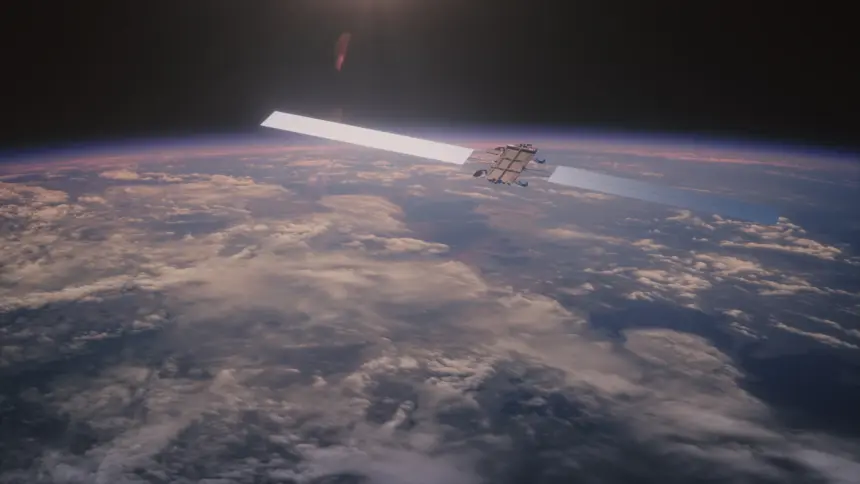
Starship IFT-14 is expected to mark an important milestone for SpaceX’s Starlink network, with the mission set to carry the first orbital, operational Starlink V3 satellites.
These new V3 satellites are expected to be another major step forward for the Starlink constellation. The new satellites will provide new backbone and backhaul capabilities for the network, taking advantage of the increased payload base space to mount more radios and optical links.
With IFT-14 tentatively scheduled for late August, SpaceX could begin shifting Starlink toward a new generation of satellites in the near future, laying the groundwork for a substantial increase in the network’s capabilities.
More Bandwidth Than Ever
Starlink V3 introduces major hardware improvements designed to increase the amount of data each satellite can handle. Each satellite is designed to provide up to 1 Tbps of downlink capacity and 160 Gbps of uplink capacity, representing roughly 10 times the downlink capacity and 22 times the uplink capacity of Starlink V2 Mini.
The increase isn’t limited to overall throughput. V3 features 2,048 downlink beams and 2,048 uplink beams, compared with 192 downlink and 144 uplink beams on V2 Mini. The satellites also feature six high capacity 400 Gbps optical inter-satellite links, allowing large amounts of data to be transferred between satellites while providing additional redundancy across the network.
Together, these improvements allow each V3 satellite to handle substantially more traffic than previous generations, giving SpaceX a way to dramatically expand Starlink’s capacity as Starship’s launch cadence increases.
Designed Around Starship
Starlink V3 also represents a shift in how SpaceX approaches the design and deployment of its Starlink satellites. Earlier generations were designed around the payload constraints of Falcon 9, requiring SpaceX to build relatively compact satellites that could be launched in large numbers. V3 takes a different approach by taking advantage of Starship’s enormous payload capacity.
The larger payload volume available on Starship allows SpaceX to build larger satellites with more powerful communications hardware and greater overall capability. SpaceX has indicated that it expects Starship to eventually carry up to 60 V3 satellites in a single launch, allowing a substantial amount of Starlink capacity to be added with each mission.
This makes Starship more than just a new launch vehicle for Starlink. Its payload capacity is becoming an important part of SpaceX’s strategy for deploying the next generation of Starlink satellites.
What V3 Means for Customers
For Starlink customers, the biggest benefit of V3 won’t necessarily be dramatically faster speeds for every individual user. Instead, the major improvement will come from the additional network capacity available as more V3 satellites enter service.
Starlink continues to add millions of subscribers, increasing the amount of traffic the network must handle. As the customer base grows, additional capacity becomes increasingly important, particularly in areas where large numbers of users share the same available capacity. V3 is designed to address this by providing substantially more capacity per satellite.
During SpaceX’s Q2 earnings call, Elon Musk estimated that V3 would need a critical mass of roughly 1,000 satellites before customers experience substantial improvements. He said SpaceX could reach that point around the second quarter of 2027, although the timeline depends heavily on Starship’s launch cadence.
The impact of V3 should therefore become increasingly noticeable as more satellites are deployed. Rather than simply increasing the maximum speed available to individual customers, SpaceX is effectively expanding the amount of bandwidth available across the network. This should give Starlink more room to accommodate its rapidly growing customer base while maintaining and improving performance as demand continues to increase.








![Falcon 9 to Launch SDA Tranche 1 Transport Layer A [Scrubbed]](https://thegridfin.com/wp-content/uploads/2026/07/SpaceX_SLC_4E_01-150x150.jpg)