On August 4th, 2026, SpaceX broadcast its very first Earnings Call webcast since it went public in June. The Q2 2026 webcast covered a lot of the key details on how SpaceX functions as a company, what it has been doing so far, and what its next steps are.
We’ve summarized the whole Earnings Call into an easy-to-read set of notes in case you missed it, including all the forward-looking statements, financial information, and even the Q&A.
Elon Musk opened the call by touching on the last two successful Starship B3 flights, the growth of Starlink to over 170 countries, and the fast movement of SpaceXAI on Grok 4.5. He also highlighted the upcoming IFT-14 launch, which will be the first full orbit for Starship, along with the first deployment of Starlink V3. The much larger V3 satellites will help SpaceX rapidly expand satellite bandwidth faster than ever, as demand continues to grow.
You can read the entire earnings call deck here.
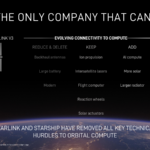
On the AI front, Grok 4.6 is supposed to launch this week, while Grok 4.7 will follow this quarter. Grok 5, an even larger step forward, will arrive by the end of 2026. Musk also confirmed that he intends to use NVIDIA’s Vera Rubin architecture, NVL72, on the first versions of the Starmind AI satellites.
Space and Launch Operations
- Space-segment revenue reached $962 million, with $648 million from launch services and $314 million from launch and development work.
- The segment recorded a $542 million operating loss and a $205 million adjusted EBITDA loss.
- Space research and development spending was $1.076 billion, up from $693 million a year ago.
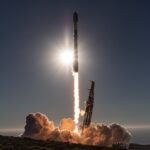
- SpaceX completed 38 launches in Q2:
- 10 customer launches and 28 internal missions
- 78 launches total during the first half of 2026.
- The company carried 485 metric tons to orbit in Q2 and 1,041 metric tons during the first half.
- Of the first-half total, 908 metric tons were internal payloads, mostly Starlink satellites.
- The executive team confirmed that Falcon currently accounts for close to 90% of worldwide mass delivered to orbit.
- This is at an annualized rate of roughly 2,500 metric tons, versus approximately 300 metric tons for the rest of the world.
- SpaceX expects Starship eventually to provide roughly four times Falcon 9‘s launch capacity while reducing cost per launch by about tenfold.
- Starshield received more than $6 billion in multi-year U.S. government awards, primarily through two major Space Force contracts covering low-Earth-orbit communications and sensing constellations.
Starship
- Starship V3 is advancing toward full and rapid reusability after Flights 12 and 13.
- Flight 12 launched from SpaceX’s new Starbase pad in May, achieved a precision upper-stage landing, and deployed modified Starlink V2 satellites on a suborbital trajectory.
- Flight 13 followed in July and achieved all planned objectives, including:
- Deploying 20 production Starlink V3 satellites on a suborbital trajectory.
- Demonstrating an in-space Raptor engine relight.
- Completing Starship’s softest splashdown to date.
- Returning the upper stage with its heat shield intact enough for detailed post-flight inspection.
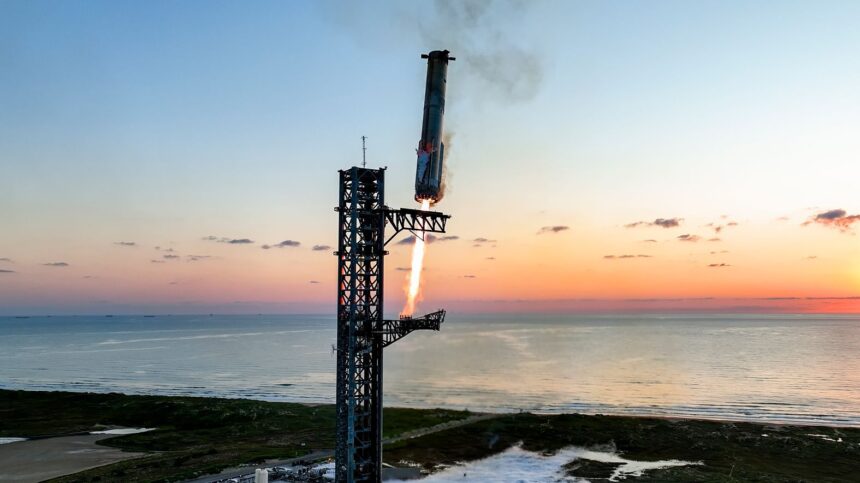
- SpaceX is tentatively targeting Flight 14 for the end of August, subject to regulatory approval.
- Flight 14 is expected to place the first Starlink V3 satellites into an operational orbit.
- Flight 13 carried production V3 satellites, but did not leave them in orbit.
- SpaceX also plans to attempt the first tower catch of the Starship upper stage during Flight 14, provided regulators approve the attempt.
- Musk said SpaceX expects Starship’s cadence to rise rapidly and suggested the vehicle could be flying at least once per day within roughly a year.
- SpaceX plans to begin launching operational Starmind orbital data-center spacecraft in 2027.
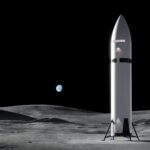
- President Gwynne Shotwell confirmed that SpaceX and NASA are still working to put astronauts on the Moon by 2028.
Starlink and Connectivity
- Starlink ended Q2 with 12 million subscribers, doubling from six million a year earlier and increasing by 1.7 million from Q1.
- Average revenue per user remained stable at $66 per month.
- This is down from $85 a year ago as Starlink expanded into lower-priced international markets.
- Consumer revenue reached $2.485 billion, up 16% sequentially and 44% year over year.
- Enterprise and government revenue reached $1.806 billion, up 63% sequentially and 108% year over year.
- Connectivity generated $1.656 billion in operating income, up 79% year over year, and $2.597 billion in adjusted EBITDA, up 64%.
- The Starlink constellation comprised approximately 10,200 broadband and direct-to-cell satellites at quarter-end, providing roughly 800 terabits per second of downlink capacity.
- Service was available across 167 countries, territories, and other markets at the end of Q2, with additional markets continuing to open.
- The executive team said that next-generation Starlink V3 satellites will deliver substantial gains in both broadband capacity and data density.
- Musk said Starlink could eventually supply a majority of global internet traffic in markets where it is permitted to operate, potentially within ten years.
Starlink Aviation and Mobile
- Starlink signed a major agreement with American Airlines during the quarter.
- The company also activated service aboard additional airlines, including Southwest, Virgin Atlantic, Iberia, and Aer Lingus.
- SpaceX described Starlink as increasingly becoming the connectivity provider of choice for major airlines and pointed to strong passenger feedback.
- New international direct-to-cell partnerships included SoftBank, NTT Docomo, and Spark New Zealand.
- SpaceX received FCC approval for the transfer of EchoStar licenses covering 65 MHz of U.S. spectrum and certain global Mobile Satellite Service spectrum rights this quarter.
- The additional EchoStar spectrum is expected to be incorporated into Starlink’s second-generation direct-to-cell satellites beginning next year.
- The executive team expects its expanded mobile service to launch in late 2027.
- SpaceX now intends to compete more directly in mobile connectivity, while continuing to work with carrier partners.
AI, Grok, and Cursor
- AI revenue reached $2.561 billion, up 213% from Q1 and 247% year over year.
- AI solutions and infrastructure contributed $2.194 billion, while advertising contributed $367 million.
- The segment remained unprofitable on a GAAP basis, recording a $1.257 billion operating loss, but turned adjusted EBITDA positive at $1.146 billion.
- That compares with a $609 million adjusted EBITDA loss in Q1.
- SpaceX expanded AI compute capacity to 1.4 gigawatts, up from 1.0 gigawatt in Q1 and 0.4 gigawatts a year earlier.
- The company is continuing to build Colossus II and is targeting 10 gigawatts of capacity by the end of 2027.
- SpaceX signed several cloud-services agreements representing $14.1 billion in contracted sales.
- Those agreements generated $1.6 billion in incremental AI infrastructure revenue during Q2.
- Management said newly deployed compute capacity currently has a payback period of less than one year, due to strong pricing and demand.
- Token consumption tripled following the July launch of Grok 4.5 and Grok Build.
- Grok 4.5 incorporates SpaceX’s 1.5 trillion parameter V9 foundation model and was developed alongside Cursor, with an emphasis on coding, agentic work, and knowledge tasks.
- Musk confirmed that Grok 4.6 will launch one week after the Earnings Call, with Grok 4.7 to follow in September.
- Grok 5, a fully fleshed out new model, will launch before the end of 2026.
- SpaceX agreed to acquire Cursor for $60 billion, subject to regulatory approval, and expects the deal to close in Q3 2026.
- SpaceX has committed to Nvidia’s upcoming Vera Rubin platform, including NVL72 systems, for its next phase of AI infrastructure.
- Musk indicated SpaceX intends to remain exclusively aligned with Nvidia for advanced AI accelerators rather than adding a second chip supplier.
Financials
- SpaceX generated $7.814 billion in Q2 revenue, up 92% from $4.071 billion a year ago and 66% from $4.694 billion in Q1.
- The company reported a net loss of $541 million, or $0.09 per share, improving by $467 million from its $1.008 billion loss in Q2 2025.
- Operating loss narrowed to $143 million from $970 million a year earlier and $1.943 billion in Q1.
- Adjusted EBITDA reached $3.538 billion, up 191% year over year and more than tripling sequentially from $1.127 billion.
- Segment revenue comprised:
- Connectivity: $4.291 billion, up 32% sequentially and 66% year over year.
- AI: $2.561 billion, up 213% sequentially and 247% year over year.
- Space: $962 million, up 55% sequentially and 29% year over year.
- SpaceX spent $18.369 billion on capital expenditures during Q2, compared with $10.107 billion in Q1 and $2.825 billion a year ago.
- AI accounted for $15.828 billion of Q2 CapEx.
- Connectivity accounted for $1.367 billion.
- Space accounted for $1.174 billion.
- Capital spending reached $28.476 billion during the first half, while operating activities generated $3.466 billion in cash.
- SpaceX ended Q2 with $93.522 billion in cash and cash equivalents and $6.487 billion in marketable securities, for approximately $100 billion in total liquidity.
- The company had $39.364 billion in current and long-term debt and finance leases at end of quarter.
- SpaceX’s June IPO raised approximately $85.7 billion in net proceeds from 638.9 million Class A shares.
- The company also completed a $25 billion investment grade bond offering with a weighted average interest rate of 5.855%.
- Management expects capital spending during each of the next two quarters to remain broadly similar to Q2.
- CFO Bret Johnsen said SpaceX is targeting a $100 billion annualized revenue run rate by the end of 2026, including Cursor—not $100 billion of ARR for the full 2026 fiscal year.
- Elon Musk said SpaceX now aims to reach $1 trillion in annual revenue by 2030, one year earlier than its previous projection, with 2029 presented as a possibility rather than formal guidance.
Analyst Q&A
This section covers the call-in questions from analysts and professional investors.
How does the backlog of enterprise and government contracts in the connectivity segment convert into revenue and growth?
SpaceX is bullish on enterprise activity through both the backlog of more than $6 billion in government contracts and Starlink has great retention and satisfaction with enterprise customers. Starlink has approximately 10% penetration in the aviation industry, with maritime services opening up further markets with affordable Starlink over VSATs.
How confident is SpaceX in achieving the 10 GW nameplate capacity by the end of 2027?
SpaceX targets 20 gigawatts of power and cooling through active projects by the end of 2027, but a more conservative estimate places it around 15 gigawatts.
How do robotics fit into the SpaceX camp?
SpaceX considers satellites as robots, they are autonomous and do not need servicing. AI and humanoid robotics will further the demand for connectivity dramatically.
Elaborate on CapEx outlook across all the segments, and how buying versus building might accelerate growth?
SpaceX sees opportunities to deploy capital in AI segments that results in a less than one year payback. Post IPO projections for $1 trillion of revenue moved up from 2031 to 2030, potentially even 2029.
What are thoughts on IFT-13? How does this relate to the journey to rapid reusability?
Flight 13 went incredibly well, and SpaceX will attempt to catch IFT-14 with the tower, pending regulatory approval. SpaceX also expects flight cadence to increase rapidly, aiming for one flight a day in 2027.
How does SpaceX’s expertise in rockets and satellites convert to compute power in the AI segment?
SpaceX foresees great success in terrestrial data centers. The research and development that go into developing space-based datacenters will help to optimize the construction of terrestrial sites.
Does SpaceX expect sustainability in premium pricing for compute deals?
SpaceX expects that both usefulness per watt and the demand for memory will rapidly increase.
Why is SpaceX confident in this year’s $100 billion in ARR, and subsequently its 2030 $1 trillion target?
SpaceX foresees massive growth in revenue following Starlink V3 with its 10x capability of Starlink V2, as well as mobile Starlink.
How does SpaceX view the mobile market?
SpaceX currently uses 5 MHz of bandwidth through local telco providers, with 65 MHz of capacity available through the EchoStar acquisition. SpaceX expects to take a chunk of the $600 billion market shared by the three largest U.S. wireless carriers following Starlink Mobile V2 starting by end of year 2027.
How does SpaceX expect to use the increase in compute capacity going forward?
SpaceX expects internal usage of training for Grok to go down, expecting usage of about 10% of capacity.
What steps does SpaceX expect to take to join the big American telecom carriers?
SpaceX plans to expand the terrestrial element, providing service from satellite and terrestrial means, with interesting and efficient CapEx ideas.
Investor Q&A
The section below covers investor-submitted and upvoted questions from SpaceX’s QuestionTime Q&A platform.
What is the current state of the HLS and prototypes of it?
Propellant transfer in orbit is the next key milestone for SpaceX and HLS.
Will SpaceX be landing a prototype of the vehicle on the lunar surface before Artemis IV?
SpaceX plans to launch an uncrewed direct to lunar cargo mission following Artemis III next year.
What kind of progress is Starship HLS at?
SpaceX expects Starship to achieve a high launch rate and meet safety standards by the end of 2027.
Will the program still be on track for the landing demo and Artemis IV?
SpaceX aims to have “boots on the ground, boots on the moon in 2028”.
How will you integrate the Cursor acquisition, and what does the product roadmap look like for the combined company?
SpaceX declines to comment ahead of regulators for the closing acquisition, but there will be discussion or announcements outside of the earnings call.
Once you start launching broadband v3 satellites, how quickly will that translate into improved Starlink service?
Broadband V3 satellites will start converting into improved service at a critical mass of about 1000 satellites. SpaceX estimates that this will happen by Q2 next year.
What’s the actual tile loss rate on the windward side after the latest entry, and is the heat shield still the hardest remaining problem?
SpaceX considers the heat shield problem effectively solved, from data and visual inspection of IFT-13.
Watch the Broadcast, Read the Deck
You can read the entire earnings call deck here.
You can also watch the entire webcast below.