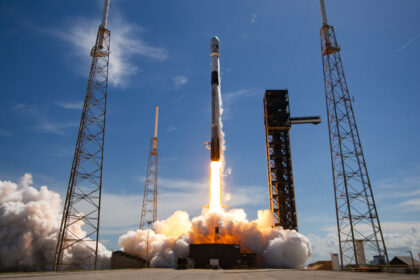
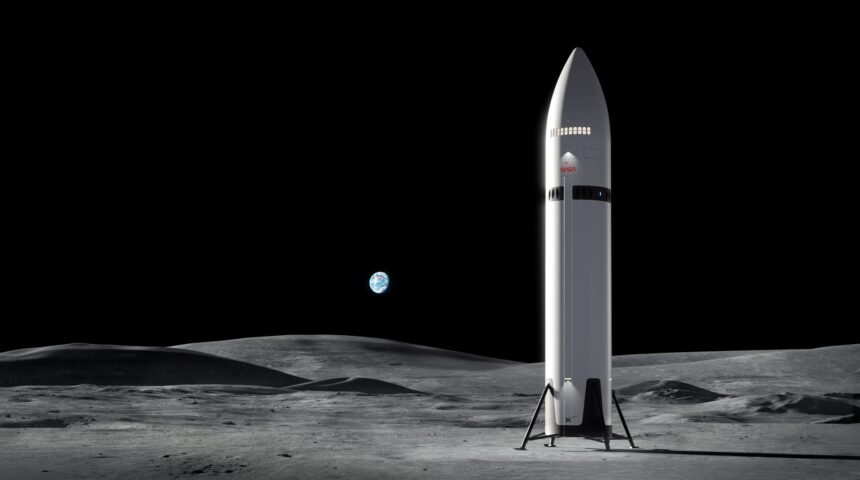
SpaceX has two Starship flights left in 2026, and NASA has laid out what it needs after that. Flight 15 will try to catch both the Super Heavy booster and the ship, and Flight 16 could be the first Starship launch from Florida, based on updated flight trackers.
NASA’s Human Landing System (HLS) team, meanwhile, used the International Astronautical Congress (Oct. 5–9) to show a quarter-by-quarter Starship schedule running to an uncrewed Moon landing demo in late 2027.
Flight 15: Two Catches, With a Nov. 8 Planning Date
NSF cites the latest CADENA planning slide, which lists Flight 15 as no earlier than Nov. 8. SpaceX hasn’t announced a date. Elon Musk has said he’s targeting four to six weeks out, before Thanksgiving, which lines up with early to mid-November.
Musk confirmed SpaceX will try to catch both stages. That would be the first attempt to recover a full Starship stack.
Both vehicles still need a static fire. Ship 42 was close to its trip to the Massey’s test site when its engines were pulled, and it made an extra trip there for a cryoproof test instead. The removal could potentially be connected to the RVac shutdown that occurred on Flight 14, but it hasn’t been confirmed yet.
Musk has called the shutdown a software glitch in that one engine’s computer. Booster 22 is believed to have all its engines and is waiting to roll to Pad 2 for its own static fire. With that said, we expect the move to the Pad to come before the end of this week.
Flight 16 and a Florida Debut
Flight 16 is aimed at December, with Booster 23 and Ship 43 the likely vehicles. Booster 23 finished an extended cryo test at Massey’s and went back to Mega Bay 1 for engines. Ship 43 is in Mega Bay 2 alongside Ships 42 and 44.
Flight 16 is tied to bringing Launch Complex 39A online before year-end, which would make it the first East Coast Starship launch.
Each vehicle would ride the barge You’ll Thank Me Later up the Banana River to Kennedy, go through checks at the new Gigabay at SpaceX’s Roberts Road facility, then move to pad 39A. There the booster would run propellant-load tests ending in a static fire, then the ship joins for integrated testing.
The switch from Block 2 to Block 3 Starship has reduced the number of expected launches this year. In addition, Pads 37A and 37B will add two Cape sites, and Pad 1 at Starbase is being rebuilt to match Pad 2. Alongside the future Starbase Louisiana, SpaceX could be up to 14 function pads within the next few years.
NASA’s 2027 Checklist for Starship
NASA’s IAC slides put these SpaceX milestones on a quarterly chart. Placements within each quarter are approximate:
- Q4 2026: first orbital flight (Flight 14 has since done that), first V3 booster catch, first ship catch, first Cape flight and first V3 booster reuse
- Q1 2027: propellant transfer demo and a second Cape pad, LC-37, complete
- Q2 2027: ongoing flight tests, plus the Artemis III ship and booster static fire and barge to the Cape
- Q3 2027: tank pressurization upgrades, the Artemis III mission and the first tanker flight for the uncrewed demo
- Q4 2027: uncrewed demo lander launch and the uncrewed lunar landing
SpaceX is also building “Cabin One,” a full-scale, flight-like crew compartment, at Starbase for operations and airlock testing. Every 2027 box depends on the next few flights, so a slip at Flight 15 or 16 could end up delaying HLS implementation.
What Artemis III and the Landing Demo Require
NASA’s paper turns Artemis III, in 2027, into an Earth-orbit test, with Orion docking with both landers. Blue Origin’s MK2 test article launches first, and the crew will go inside it for limited life-support testing. SpaceX’s article is a standard Starship V3 with a docking assembly on the nose cone, no life support, and no crew going inside. It is expected to launch from SpaceX facilities currently under construction at NASA Kennedy.
For the uncrewed demos, each lander has to touch down autonomously within 100 m of its target, send telemetry home for at least two hours, and relight a main engine on the Moon. Artemis IV, in early 2028, would be the first crewed lunar landing since 1972, followed by Artemis V in late 2028. NASA hasn’t picked the lander for either.
Cargo versions of both landers will carry 15 metric tons (about 33,000 lb), and NASA intends to award SpaceX delivery of JAXA’s pressurized rover, no earlier than fiscal 2032. NASA says Blue is rebuilding its launch facilities at Kennedy after a May 2026 pad mishap at LC-36 and aims to return New Glenn to flight before the end of 2026.