
Grok Bot is rolling out with several new key features this week on both desktop and mobile. Your Bots are now able to send voice notes, as well as have active voice chats. In addition, the Cursor team was hard at work behind the scenes, and wrung out another set of optimization improvements, stretching included usage by about 10%.
For people who already treat the Bot as a teammate, that is three practical moves in one pass: talk to it live, get audio replies you can play later, and keep more of your allotment when the harness wastes fewer tokens.
Grok Bot Voice
Grok Bot Voice was officially announced on 17 September, with a short demo posted on X. The rollout for users began almost immediately, at least for users on desktop. For mobile users, at the time of writing, the feature is still rolling out selectively to both iOS and Android devices over the next few days.
In late August, we posted that @blankspeaker spotted a “Start a Voice Call” control in the Grok Bot UI. That was our first hint that the feature was coming soon, and just three weeks later, it has finally arrived for users.
If you’re working on physical tasks or typing away, talking can help you do more faster. Voice helps to turn Bot from a typed teammate that’s away from you into something you can run while driving, cooking, or walking your dog. You can narrate context out loud instead of typing a perfect prompt out first, and then jump back to the keyboard when you need more precision in your language.
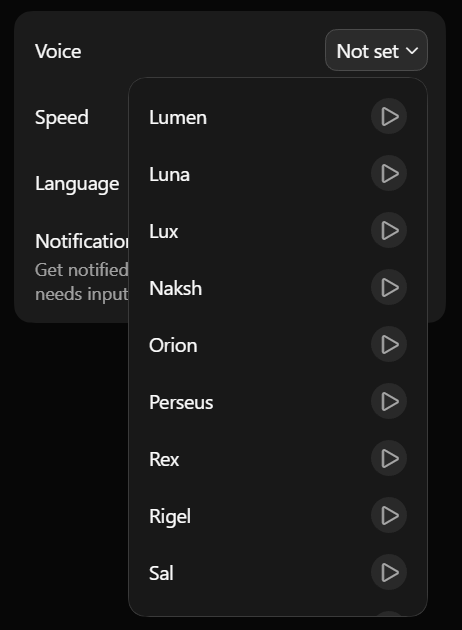
Grok Bot Voice is available in all supported Grok Voice 2.0 languages, which is the full list of currently supported typed languages available in the Grok Bot app as well. You can also select from the same list of Voices that are available for Grok Voice 2.0, and each Bot can have its voice, voice speed, and language set automatically.
If you do not select any particular options, Grok Voice will default to the Altair voice personality, at 1x speed, in your default UI language.
Grok Bot Voice Notes
The next day, on 18 September, a second product that we didn’t see a preview of released. Grok Bot now has the capability to send responses as Voice Notes, as long as you ask. Voice Notes come back in your preset language, speed and voice selection.
Voice Notes provides more of an asynchronous piece to the entire spoken-voice puzzle. A live Voice call is a conversation you have to be present for, but a voice note is more like voicemail. It is something the bot can drop for you to play later, like a status, a summary, or a reminder, without holding an open call.
This is the same pattern as other handoffs with your Bot. Your Bot does the work, and you can listen to the result once your ears are free and ready.
For shopping, research, or multi-step chores already running in the background, an audio note can be faster to absorb than another wall of text on a phone screen. It also pairs well with Voice. You can talk through the brief live, then let the Bot send a spoken wrap-up you can replay on the commute.
Token Optimization / Usage
The same afternoon Voice shipped, Jedediah Katz said harness work is giving users another roughly 10% more effective usage — with a blunt tip that big group chats between your Bots is likely more pain than its worth.
Katz said the team rolled out more optimizations “to give you another 10% more effective usage.” This round, he said, boiled down to reducing overuse of subagents, less noisy bot-to-bot chatter, and smarter routing for low-effort batch work.
Those are some pretty concrete changes. Subagents that fire too often burn tokens on parallel work that’s already being accomplished anywhere. In addition, noisy and needlessly wordy bot-to-bot chatter when handing off tasks is a tax that doesn’t need to be as heavy as it currently is.
Paired with smarter routing for low-effort batch work, simple chores and tasks should now use lower-effort thinking paths, which helps to save tokens. Overall, this is a harness optimization path, which helps to reduce user token consumption. That’s both a plus for users of Grok Bot, as well as SpaceXAI, as they have to process less waste tokens each turn.
Just two weeks ago, Katz had already flagged more changes to the harness on routing, caching, dynamic contexts, and overall token efficiencies. Those earlier changes were on average 10%, and sometimes up to 35% more efficient with token use. Putting that together, it seems that each week the Grok Bot harness is getting more and more efficient, letting users get more out of their subscription.
If the harness wastes fewer tokens on redundant subagents and noisy chatter, the same subscription covers more real work before you hit your usage limit and need to pull out your wallet. For price-sensitive users of Grok Bot, this is a big win, as you’ll be able to get more work done out of your Bot before needing to pay API fees, especially for routine tasks and multi-step asks.
Cutting Down on Group Chats
Katz’s pro tip cuts the other way. Group chats, he said, are “super token guzzlers,” and the bigger the group, the more it costs. He is not sure the ROI is there for most people, and he floated that the team might need to limit group chats until the burn is under control.
And a pro tip: beware group chats! They are super token guzzlers and frankly I’m not sure the ROI is there for most people. The bigger the group chat, the more it costs. If you’re price-sensitive I would avoid these for most work. We might need to limit these until we can bring it under control.
So, besides increases in efficiency, it seems that it would be best to kill or park your group chats unless they’re absolutely needed. The more bots you bring you a group chat, the more times a message needs to be processed on a per-agent basis.