A Different Kind of Return
Starship cannot return like an aircraft or the Space Shuttle, and it is not designed to descend vertically under engine power from space. Either approach would demand too much propellant or add heavy wings and landing systems. Instead, the spacecraft uses the atmosphere to lose most of its speed, protects itself from reentry heat and saves its engines for the last moments of flight.
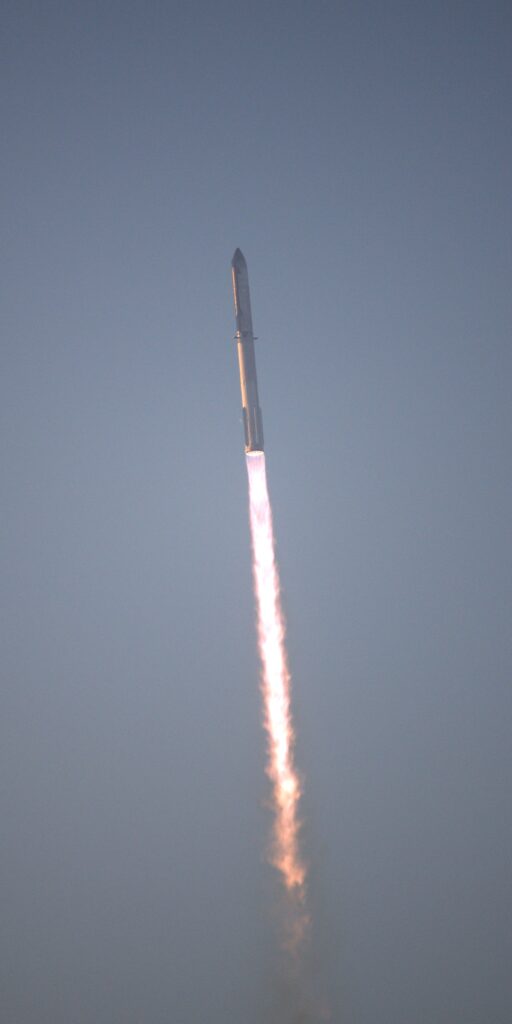
That sequence is one of the clearest differences between the ship and its Super Heavy booster. Super Heavy returns tail-first and uses grid fins for steering. Starship reenters with its broad heat-shielded side facing the airflow, falls in a controlled horizontal attitude, then flips upright shortly before landing.
SpaceX proved the basic low-altitude version of this manoeuvre during early suborbital tests. Integrated flight tests have since explored the much harder problem of returning from orbital-class speeds, where heating and structural loads are far greater.
Surviving Reentry
As Starship meets the upper atmosphere, its velocity turns the thin air into an intense source of heat. Thousands of dark thermal-protection tiles cover the side of the stainless-steel ship intended to face the airflow. The tiles insulate the structure and propellant systems beneath them.
The spacecraft’s attitude is critical. If it exposes an unprotected area or loses control, heating can damage the vehicle quickly. Starship uses two forward flaps and two larger aft flaps to manage lift, drag and orientation. By moving them independently, the flight computer can adjust the ship’s pitch, roll and yaw as it follows its reentry path.
A heat shield is not a single solved component. Tiles must remain attached through launch vibration, survive extreme temperature changes, and cover complex areas around hinges and seams. SpaceX has changed tile designs, flap locations, and other details between generations as flight data exposed weaknesses.
One of the biggest challenges facing SpaceX today is the materials science around the heat shield. One vehicle surviving reentry doesn’t mean that the same heat shield can be turned around and reused without considerable maintenance or replacement yet.
The Belly-Flop Descent
After the fastest and hottest part of entry, Starship settles into its distinctive belly-flop flight pattern. The ship descends roughly horizontally, presenting a large area to the airflow. That creates drag and slows it without requiring continuous engine thrust.
The four flaps don’t act like wings to create lift, but instead use the created drag to adjust the ship’s attitude and steer it towards the landing zone. The goal is to arrive at the flip point with the correct position, velocity, and orientation.
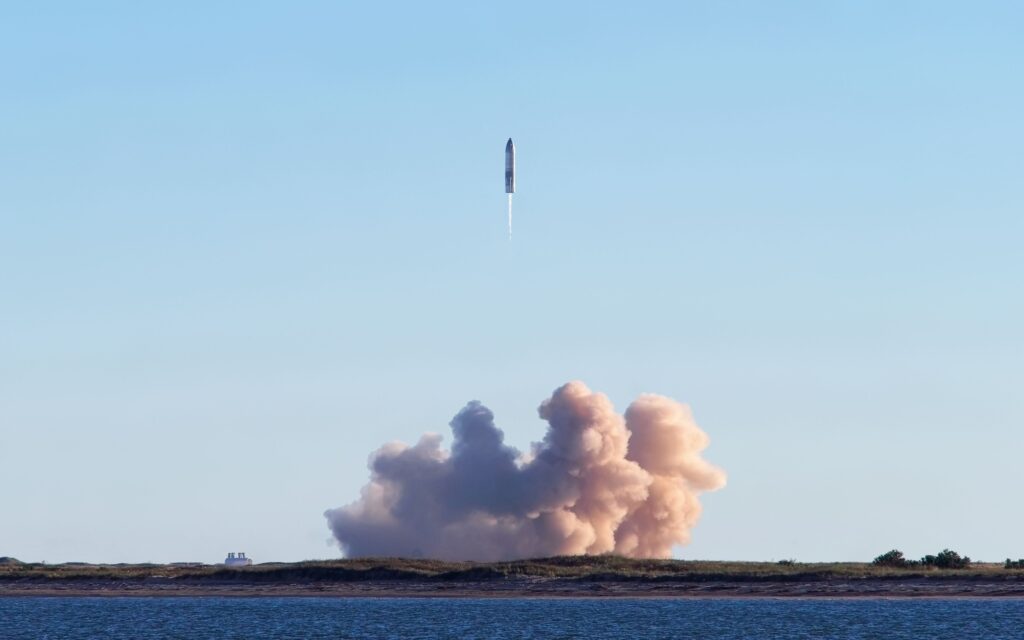
This descent also spreads aerodynamic forces and heating across the protected side of the vehicle. It lets a very large spacecraft use the atmosphere as a brake while preserving propellant for landing. The trade-off is that the ship must execute a dramatic transition close to the surface.
The Flip and Landing Burn
Near the water or landing site, Starship relights sea-level Raptor engines and begins the landing flip. Engine thrust and flap movement rotate the ship from horizontal to vertical. The engines then reduce its downward speed and guide the tail toward the target.
Propellant management is especially difficult during this manoeuvre. Most propellant has been consumed, and liquid inside the tanks does not automatically stay settled over the engine inlets as the vehicle falls and rotates. Smaller header tanks retain landing propellant and help provide a reliable supply during the flip. The engines must ignite on command, produce stable thrust and give the guidance system enough control to correct errors within seconds.
An operational Earth-returning Starship is intended to finish upright, landing cradled in the arms of Mechazilla in the future. For now, SpaceX uses soft ocean splashdowns as the integrated flight testing program continues.
Recovery Is Still the Hard Part
The landing burn is visually dramatic, but reusability depends on the entire return. The ship must survive reentry with its structure, flaps, plumbing, avionics and engines in a condition that makes recovery worthwhile. It must then be inspected and prepared for another flight without rebuilding large portions of the vehicle.
Flight tests have demonstrated controlled entries, flips, landing burns, and splashdowns, while also revealing failures in thermal protection, attitude control, and propulsion. That is normal for a development campaign, but it is why “designed to be reusable” is more accurate than saying Starship is already routinely reusable.
Super Heavy has its own recovery challenge: it uses grid fins, engines, and the launch tower rather than a belly-flop. The companion article on the booster explains that catch. Together, the two return profiles show the scale of SpaceX’s bet. Recovering not just the first stage, as Falcon 9 commonly does, but the spacecraft as well.







![Falcon 9 to Launch SDA Tranche 1 Transport Layer A [Scrubbed]](https://thegridfin.com/wp-content/uploads/2026/07/SpaceX_SLC_4E_01-150x150.jpg)