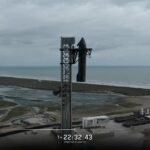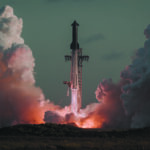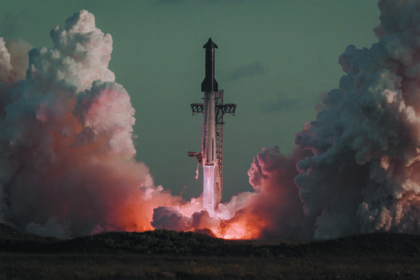
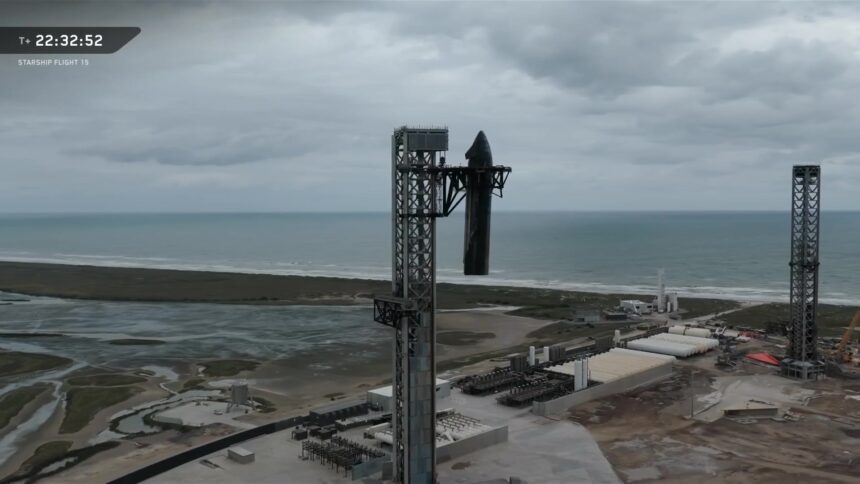
SpaceX’s Starship Flight 15 lifted off from Starbase, Texas, on Friday, Nov. 13, at 5:47 p.m. ET and put all 26 Starlink V3 satellites in orbit. The ship reached its nominal orbit, and on Saturday it came back and was caught at the tower — the first catch of a Starship upper stage.
The Super Heavy booster did not come back: it aborted its catch, diverted to an offshore splashdown in the Gulf, and its flight termination system fired. The root cause of the booster miss is still unknown, but SpaceX speculated on the automated abort being related to low fuel.
Liftoff of Starship! pic.twitter.com/lc7UtE6H7z
— SpaceX (@SpaceX) November 13, 2026The flight was supposed to be the first catch of a Super Heavy V3 booster and the first time SpaceX brought both stages of an orbital launcher back to the pad. Three earlier V1 boosters were caught, and two of those flew again, according to SpaceX’s Flight 15 mission page. You can find a preview of the Flight 15 plan here, if you wanted to see the background.
The Booster Aborts the Catch
Liftoff and hot-staging went as planned. At 5:51 p.m. ET, SpaceX said Super Heavy was “boosting back towards Starbase for a catch.” Four minutes later it posted that “Super Heavy has diverted to an offshore splashdown in the Gulf.”
Super Heavy has diverted to an offshore splashdown in the Gulf pic.twitter.com/1M2xn7NYJA
— SpaceX (@SpaceX) November 13, 2026On the company webcast, SpaceX’s Dan Huot first said the booster “aborted itself for a GNC issue that it detected.” The next day he walked that back. “It was not a GNC issue that caused us not to come back,” he said, according to Space.com and Spaceflight Now.
“GNC triggered that abort; it was doing what it was supposed to do. Basically, [it] detected that the booster was not in the place that it was supposed to be to proceed with a catch, did an automated abort and then headed out to that offshore splashdown location.”
He said SpaceX is “still digging into the root cause.”
Huot also said the booster lit its landing-burn engines, hovered, shut them down, and that the flight termination system then triggered, just above the water, about 6.5 minutes after liftoff.
Elon Musk later offered his own explanation: “Booster was slightly low on fuel,” and “slight underperformance of engines on this flight is the reason.” He said a green flame seen on descent was “burning copper from depleting fuel in the regenerative cooling circuit.”
SpaceX’s mission page later said the booster relit 32 of 33 Raptors for the boostback burn and that the burn ended early due to low fuel mass, with the root cause under investigation. Musk also said the next booster is “almost ready for flight,” but that “losing the tower or launch mount would potentially cost us 2 to 3 months.”
All 26 Starlink V3 Satellites Reach Orbit
While the booster turned out to sea, the ship kept going. SpaceX called “Go for orbit!” at 6:11 p.m. ET and confirmed an orbital insertion burn into a ~275 km orbit at 6:15 p.m. — “orbit of Earth for the second time.” Payload deploy started around 6:27 p.m. and ran about 42 minutes. At 7:06 p.m. ET, SpaceX said: “Payload deploy complete. All 26 @Starlink V3 satellites are in orbit.”
Payload deploy complete. All 26 @Starlink V3 satellites are in orbit pic.twitter.com/y2ffFifGdo
— SpaceX (@SpaceX) November 14, 2026SpaceX’s mission page says each Starlink V3 satellite adds 1 terabit of capacity, and that all 26 equal about 10 Starlink V2 Mini launches on Falcon 9. The Starlink account said the payload “will add up to 26 Terabits of capacity to the constellation.” After deploy, the satellites unfold their antennas and solar arrays, raise their orbits on their own thrusters, and, SpaceX says, should be able to serve customers “as soon as a few weeks after launch.”
After the deploy, SpaceX said Starship was in a long coast around Earth of about 21 hours, with early deorbit options available, and that “all systems are looking good right now.”
Ship 42 Is Caught at Starbase
Overnight, SpaceX said “Starship and its heatshield are healthy.” At 10:41 a.m. ET Saturday, pad and tower systems were “go for catch.” At 2:18 p.m. ET, “Teams have polled go to return Starship to the launch site at Starbase.” The ship then relit a single Raptor sea-level engine for the deorbit burn. At 3:25 p.m. ET, SpaceX said: “Good deorbit burn. Starship is on course to reenter Earth’s atmosphere ahead of a planned catch at Starbase in ~1 hour.”
Good deorbit burn. Starship is on course to reenter Earth’s atmosphere ahead of a planned catch at Starbase in ~1 hour pic.twitter.com/eQPUx9klvM
— SpaceX (@SpaceX) November 14, 2026“Starship is reentering Earth’s atmosphere,” SpaceX posted at 3:58 p.m. ET. According to the Flight 15 mission page, the ship flew back toward the east coast of Texas, made a final “swoosh” maneuver over the Gulf, and “approached the same launch site it had just left” 22.5 hours earlier. At 4:18 p.m. ET, SpaceX said it was “executing a banking maneuver and final approach.”
Starship is reentering Earth’s atmosphere pic.twitter.com/b0M87R1SHn
— SpaceX (@SpaceX) November 14, 2026Starship is executing a banking maneuver and final approach as it returns to Starbase for a catch pic.twitter.com/E1WpGrlfaz
— SpaceX (@SpaceX) November 14, 2026The mission-page timeline puts the landing burn start at T+22:32:16, with three Raptors lit, then a landing flip, a cut from three engines to two and then to one, and shutdown and catch at T+22:32:34 — about 4:20 p.m. ET. SpaceX says the ship broke through the clouds before the flip and descended into the tower’s waiting arms, “which closed to catch Starship for the very first time.”
Mechazilla catches Starship! Congratulations to the entire SpaceX team on this incredible achievement! pic.twitter.com/YJzmGUZb2B
— SpaceX (@SpaceX) November 14, 2026On the company webcast, SpaceX’s Dan Huot called it “the missing link” and “the holy grail of spaceflight, plummeting through fire to be snatched out of the air by steel,” according to Space.com. “We caught a Starship, and now everything changes.” SpaceX later wrote: “On Saturday, November 14, Starship returned to Starbase, Texas, and changed everything.” Elon Musk posted “Inspecting ship 42 right now,” then “Ship 42 looks great!” and “I hugged ship 42 upon its return.”
The future of human spaceflight has never looked so good before.