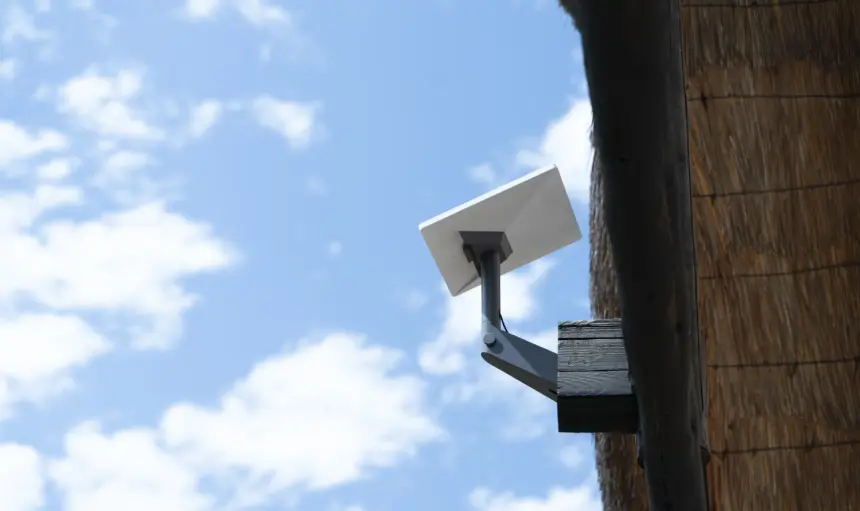
One of the greatest advantages of the modern Starlink dish is how mechanically simple it is. Instead of continuously rotating a conventional, large antenna to follow a satellite, SpaceX steers the radio beams electronically.
That capability comes from a phased array, which is a grid of antenna elements whose signals are delayed by carefully controlled amounts. Those tiny phase differences cause the combined radio energy to reinforce itself in a chosen direction. Change the delays and the beam moves, even though the antenna remains stationary.
Phased arrays are fast and precise, but they can also be expensive. A conventional two-dimensional array requires many antenna elements, phase shifters, and power amplifiers. SpaceX Patent US 11,239,553 B2, titled “Uni-Dimensional Steering of Phased Array Antennas,” explores a way to simplify that hardware by taking advantage of something SpaceX already knows: where its satellites are going.
The Cost Hidden Inside the Dish
Every active element in a phased array brings supporting electronics. Scale that across a consumer terminal, and component count affects manufacturing cost, power consumption, heat, and reliability.
Full two-dimensional electronic steering can adjust a beam across two axes. That flexibility is valuable when targets may appear anywhere, but a planned satellite constellation is not random. Its spacecraft follow predictable orbital tracks.
SpaceX’s patent proposes aligning the antenna with a repeating ground-track direction and electronically steering primarily along that axis. A separate gain-enhancement system focuses or strengthens the radio signal in the perpendicular direction.
In short, the antenna divides the work into two components. The electronics handle the steering in one direction, while the passive or less complex RF structures of the antenna concentrate the signal in the other.
Lenses, Reflectors and Resonant Structures
The patent describes several possible gain-enhancement systems. One version uses an RF lens built from layers with different refractive properties. Another uses curved or angled reflective surfaces to focus radio energy onto selected antenna elements. A third design uses a superstrate grating to create a resonant cavity and improve the directivity of the steered beam.
These structures are not optical lenses and mirrors in the everyday sense, but function similarly. Just as a glass lens bends visible light toward a focal area, an RF structure can shape radio waves so fewer active components are needed.
Because phase shifting is only required in one direction, the design can reduce the number of phase shifters in the array, which reduces cost and complexity
The patent explicitly connects that lower element count with fewer integrated circuits and power amplifiers, reduced power consumption, smaller size and potentially improved reliability.
Steering Toward a Moving Satellite
SpaceX also describes arrays arranged around a circumference, with different sections facing different directions. A controller can use satellite location data and the antenna’s own position to activate the elements best aligned with an available spacecraft.
Elements facing away from the useful signal can be switched off. That conserves energy and may leave them available for another satellite link. The design is broad enough to cover communication in bands including Ka and V band, as well as several different focusing structures.
Affordability is Key
Starlink could not become a mass-market service if every customer terminal cost as much as specialized commercial satellite equipment. SpaceX depends on manufacturing innovation just as much as it depends on orbital mechanics.
This patent for uni-directional phase steering is a path for SpaceX to cut component costs even further. Instead of making each individual part slightly cheaper, eliminating entire parts is far simpler. After all, Elon Musk’s engineering philosophy is that no part is the best part, and this is a direct application of it.
That philosophy mirrors SpaceX’s wider approach towards vertical integration. SpaceX controls the satellites, their orbital arrangement, network scheduling, and user terminal. It can design those pieces together instead of treating the antenna as a generic product that must work with an unknown constellation.