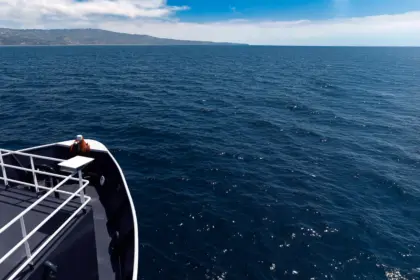
In the remote waters of the Pacific Ocean, on Omelek Island in the Kwajalein Atoll of the Marshall Islands, a significant chapter in the early history of SpaceX unfolded.
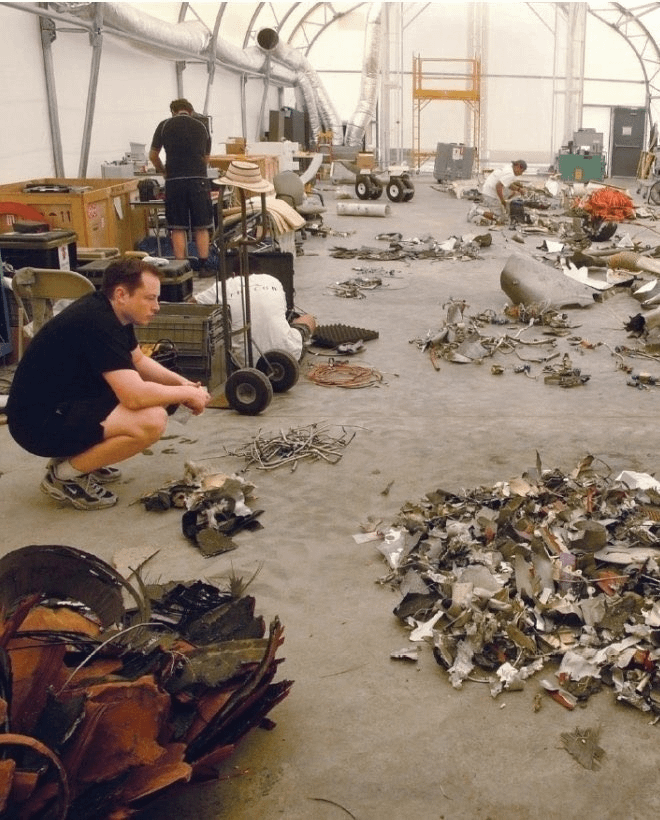
An image showing Elon Musk and his team examining debris from a Falcon 1 rocket launch was captured at this location. Over time, the photograph became widely associated with a different moment in the company’s history.
The Image That Came to Represent SpaceX’s Resilience
The image was frequently and incorrectly attributed to 2008, a period when SpaceX faced severe financial pressure. Following the three consecutive failures of the Falcon 1 launch, the company was left in dire financial straits. Because Falcon 1 had been entirely privately funded, the company was left what remained of Elon’s personal fortune split between SpaceX and Tesla. This was further exacerbated by the 2008 global financial crisis, where the US government had cut down development spending.
With three failed launches behind it, a fourth failure could have ended SpaceX altogether. Musk has since described 2008 as one of the most difficult years of his life, recounting his near nervous breakdown, being broke and in debt. Because of this, the image of Musk standing among rocket debris became widely associated with the company’s near collapse, despite being taken two years earlier.
How the 2008 Crisis Became Linked to the Image
The confusion likely arose from a series of coincidences surrounding the hurried preparations for the fourth Falcon 1 launch. Although the second stage could be reasonably transported by air, the much larger first stage was never intended for airlift. In a bid to prepare the fourth launch within 6 weeks, the Falcon 1 first stage was disassembled and transported aboard a Boeing C-17 Globemaster.
This was not without difficulty, as the liquid oxygen tank pressurized at altitude during flight. As the aircraft rapidly descended, the liquid oxygen tank began to crumple due to the difference in pressure. SpaceX’s engineers managed to open and stabilize the empty tank before it fully collapsed, ensuring that Falcon 1 IFT-4 could still launch.
This demonstrated just how dire the situation was in 2008, where SpaceX engineers would risk their lives to ensure the mission went through. They were ultimately successful, with Falcon 4’s fourth launch occurring on September 28, 2008, less than eight weeks after the third launch on August 3, 2008.
When History and Symbolism Collided
By the end of 2008, SpaceX’s future had been transformed. Following the successful fourth Falcon 1 launch and NASA’s award of a $1.6 billion Commercial Resupply Services (CRS) contract, the company’s survival was no longer in doubt. Those challenges paved the way for Falcon 9, Dragon, and the development of Starship, establishing SpaceX as a leader in the commercial space industry.
In June 2026, Elon Musk became the world’s first trillionaire following the IPO of SpaceX, contrasting the company on the verge of failure in 2008. As a result, the photograph became a reminder of SpaceX’s early challenges, even though its true context belonged to the aftermath of the company’s maiden Falcon 1 flight rather than the later crisis of 2008.





![Falcon 9 to Launch SDA Tranche 1 Transport Layer A [Scrubbed]](https://thegridfin.com/wp-content/uploads/2026/07/SpaceX_SLC_4E_01-150x150.jpg)