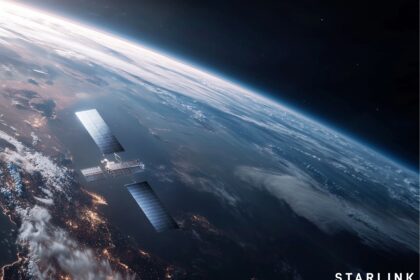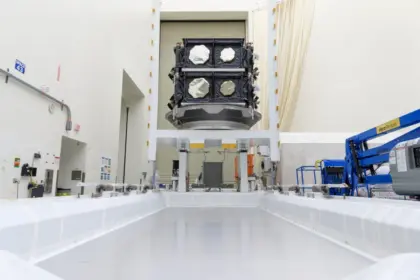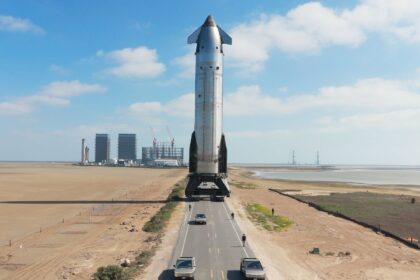

The FCC has licensed SpaceX to build a new 15,000-satellite constellation for Starlink Mobile, its direct-to-phone service. The Space Bureau and Wireless Telecommunications Bureau adopted and released Authorization and Order DA 26-1078 on Tuesday, Oct. 6, granting the application in part and deferring the rest.
SpaceX already offers direct-to-cell service from its Gen2 Starlink satellites using partner spectrum, under FCC orders from Nov. 26, 2024 and Jan. 9, 2026. The new constellation is a separate system built for phones; SpaceX filed for it on Sept. 19, 2025. This licence is also separate from the FCC’s Sept. 30 satellite spectrum vote and SpaceX’s Section 214 carrier authority.
What the FCC Granted
The licence covers Mobile Satellite Service (MSS) and Supplemental Coverage from Space (SCS) inside the U.S., and MSS and direct-to-cell outside it, plus satellite backhaul and control links. Service abroad still needs each country’s own licence.
In the U.S., the grant includes T-Mobile’s PCS G-block at 1910–1915 and 1990–1995 MHz. It also includes bands SpaceX is buying from EchoStar: AWS-3 unpaired at 1695–1710 MHz for uplink, AWS-H at 1915–1920 and 1995–2000 MHz, and 2 GHz MSS at 2000–2020 and 2180–2200 MHz.
The satellites will fly in nine shells, from 326 km at 96.87° inclination to 335 km at 26°. SpaceX must have 7,500 satellites launched and operating by Oct. 7, 2032, and all 15,000 by Oct. 7, 2035. The licence term is 15 years from the first satellite in orbit.
The Lease Waiver
FCC rules (47 CFR 25.125(a) and (b)) require an SCS provider to hold a lease arrangement with a terrestrial wireless licensee. The order waives that requirement for SCS in the authorized AWS-3 and AWS-H bands only, across the continental U.S., Alaska, Hawaii, Guam and the Northern Mariana Islands, and American Samoa. The waiver cannot be transferred to another licensee. The FCC expects it to:
…lead to increased choices for mobile device users for communications networks, initially by supplementing service availability in hard-to-reach geographic areas of the country and ultimately through increased competition in the provision of retail wireless services to American consumers.
FCC, Authorization and Order DA 26-1078
SpaceX has not announced U.S. pricing or plans for direct-to-consumer service.
EchoStar Stays Offline For Now
The EchoStar bands are test-only. Apart from launch and early-orbit payload testing, SpaceX cannot start operations in the 2 GHz MSS/AWS-4, AWS-H and AWS-3 bands until Step Two of its EchoStar transaction closes. PCMag and Notebookcheck put that closing at Nov. 30, 2027.
The FCC deferred the 2020–2025 MHz uplink band in the U.S. and the wider 1429–2690 MHz direct-to-cell request outside the U.S. SpaceX must protect other services in several bands, shut down on notice of harmful interference and meet interim 911 rules for SCS. It has 30 days from release to decline the grant as conditioned.
SpaceX agreed in September 2025 to buy the EchoStar spectrum for about $17 billion. The FCC approved the licence assignment on May 12, 2026, with a $2.4 billion escrow condition.
Version 1 vs SpaceX’s Version 2 Claims
Today, there are 650 satellites behind Starlink Mobile, which it calls version 1. In the U.S. it works only through T-Mobile’s T-Satellite, at data speeds around 4 Mbps. This is currently enough to support emergency usage and messaging apps, and carriers abroad are adding it, such as Beeline in Kazakhstan.
SpaceX says the new V2 system will deliver up to 150 Mbps per user, which it calls “5G speeds.” It projects the first Starlink Mobile V2 satellites will launch by the time Step Two closes. SpaceX also plans to pair the satellites with low-cost ground femtocells for suburban and urban coverage.
FCC Objections Filed
Globalstar, Viasat and Iridium filed petitions to deny. DarkSky International, the National Radio Astronomy Observatory, Eutelsat/OneWeb, DIRECTV, Ligado, Liberty Latin America and the Mobile Satellite Services Association filed comments. The objections centred on radio interference and light pollution, and the FCC declined further environmental review under NEPA for the time being.





![Falcon 9 to Launch SDA Tranche 1 Transport Layer A [Scrubbed]](https://thegridfin.com/wp-content/uploads/2026/07/SpaceX_SLC_4E_01-150x150.jpg)