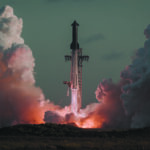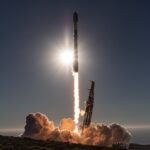
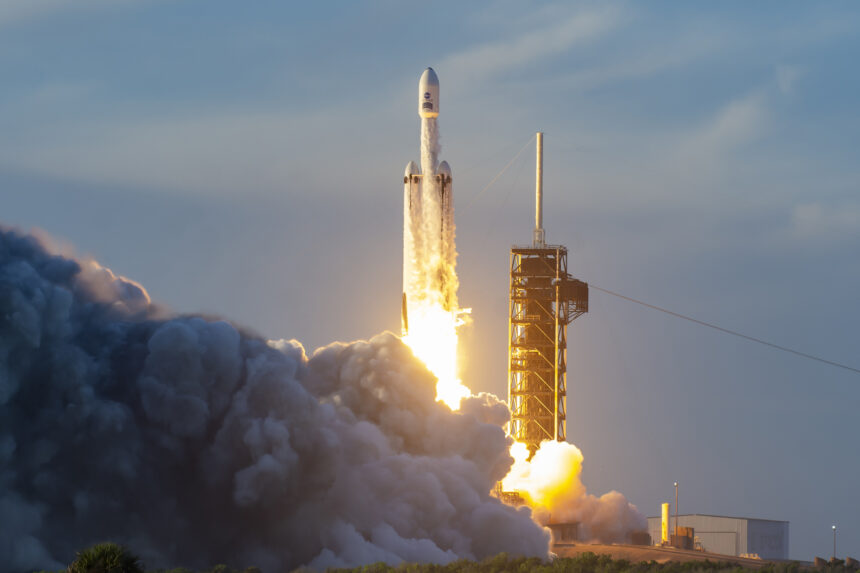
NASA and SpaceX successfully launched the Nancy Grace Roman Space Telescope at 7:26 a.m. EDT Sunday aboard a Falcon Heavy from Launch Complex 39A at Kennedy Space Center. According to NASA, the Falcon Heavy performed as expected, with the observatory successfully separating 31 minutes into flight and both side boosters subsequently returning to the launch site for refurbishment.
Off the Pad, On Its Own
Ground controllers at NASA’s Goddard Space Flight Center in Greenbelt, Maryland, established initial communications through a NASA Tracking and Data Relay Satellite seven minutes after liftoff, receiving telemetry at 7:33 a.m. EDT. Roman then completed spacecraft separation from the upper stage at 7:57 a.m. EDT, embarking on a three-month cruise toward its target orbit around the second Sun-Earth Lagrange point, L2, roughly 1,500,000 km (1,000,000 mi) from Earth.
NASA confirmed that the spacecraft’s solar panels and lower instrument sunshade deployed an hour and 23 minutes after launch. Controllers are preparing to deploy the high-gain antenna and aperture cover, alongside executing the first of two planned mid-course trajectory corrections.
This was the fourth primary payload NASA’s Launch Services Program has flown on Falcon Heavy, after Psyche, GOES-U, and Europa Clipper. NASA said the program worked with SpaceX earlier this year to pull the launch forward so the telescope could fly once it was finished, nine months ahead of the original schedule.
What Roman Is Built to Do
NASA named the telescope after its first chief astronomer, Nancy Grace Roman, regarded as the mother of the Hubble Space Telescope. With a field of view at least 100 times larger than Hubble’s, Roman utilizes infrared imaging to survey the sky far faster than its predecessor from L2. Roman’s primary surveys will focus on dark matter, dark energy, and exoplanets, with room for a lot of other astrophysics surveys.
The mission has a five-year primary lifetime and a goal of operating for 10 years. NASA intends to publicize scientific data after processing following the initial three-month commissioning period. NASA expects first images to be available by early 2027.
NASA said Roman will send back 1.4 terabytes of data every day, the highest data rate of any NASA astrophysics mission so far. First light still sits on the other side of commissioning.