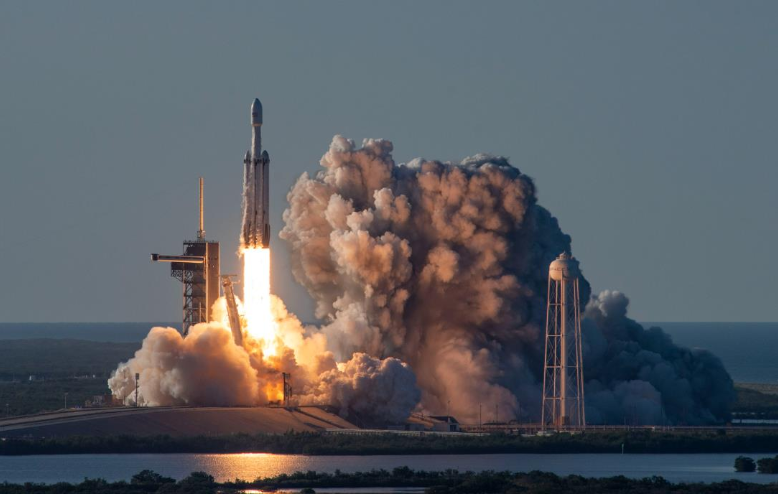
During the early stages of Falcon 9‘s development, SpaceX recognized the need for a rocket capable of carrying substantially heavier payloads. Government spacecraft, national security missions, large commercial communications satellites, and ambitious deep space probes often exceeded Falcon 9’s performance or required higher energy trajectories.
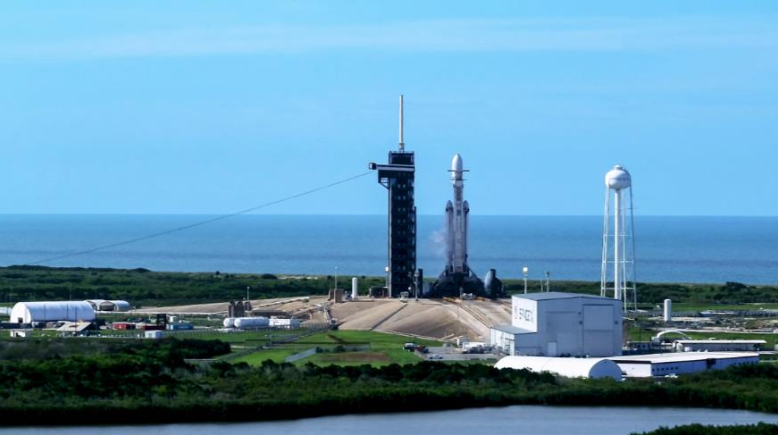
Rather than designing an entirely new launch vehicle from the ground up, SpaceX chose to build upon the existing Falcon 9 platform. The result was Falcon Heavy, a reusable heavy-lift rocket capable of delivering large payloads to low Earth orbit (LEO), geostationary transfer orbit (GTO), the Moon, Mars, and beyond. Falcon Heavy accomplishes this while offering maintaining lower launch costs than traditional alternatives.
Today, Falcon Heavy launches exclusively from Launch Complex 39A (LC-39A) at NASA’s Kennedy Space Center in Florida.
Beyond Earth
When SpaceX officially unveiled Falcon Heavy in 2011, the company’s long term vision extended far beyond Earth’s orbit. Before Starship entered development, Falcon Heavy represented SpaceX’s most powerful launch vehicle and was expected to play a central role in Elon Musk’s vision to colonize Mars. Falcon Heavy demonstrated its capability with its maiden flight on February 6, 2018, when Elon Musk’s Tesla Roadster was launched into orbit around the Sun.
Although Starship has since become the company’s primary platform for future ambitions, Falcon Heavy continues to serve an important role by launching high value scientific, commercial, and national security missions that demand exceptional lift capability and proven reliability.
Three Core Architecture
Falcon Heavy achieves its remarkable performance by combining three modified Falcon 9 first stage cores into a single launch vehicle. A core, in essence refers to a complete Falcon 9 first stage. At liftoff, all 27 Merlin 1D engines ignite simultaneously, generating more than 22,800kN (5 million pounds) of thrust and ranks Falcon Heavy among the most powerful rockets ever built.
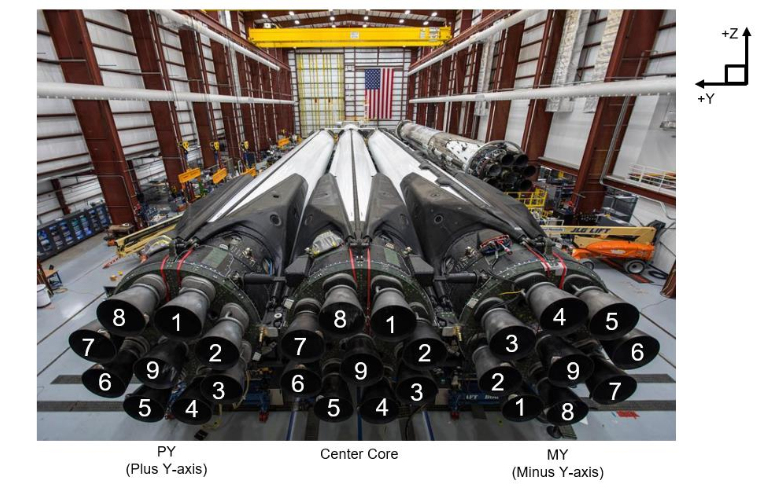
While the vehicle appears to be little more than three Falcon 9 boosters strapped together, the architecture is considerably more sophisticated. The center core is heavily reinforced to withstand the enormous structural loads imposed by the attached side boosters during ascent. Additional strengthening around the interstage, attachment points, and internal structure enables it to support the combined thrust of all three cores while carrying the second stage and payload.
Internally, the center core also differs from the side boosters through modified propellant plumbing and a unique flight profile. Shortly after liftoff, it throttles down to conserve propellant while the side boosters provide most of the vehicle’s thrust. Once the side boosters separate approximately two and a half minutes into flight, the center core returns to full power and continues accelerating the rocket toward orbit.
Reusable Heavyweight
One of Falcon Heavy’s defining achievements is extending SpaceX’s reusable launch technology to a heavy-lift rocket. Following separation, the two side boosters perform boostback, entry, and landing burns before returning to Earth for vertical landings at Landing Zones 1 and 2 at Cape Canaveral, or on autonomous drone ships depending on mission requirements. Their synchronized landings have become one of the most recognizable demonstrations of SpaceX’s reusable rocket technology.
The center core follows a far more demanding trajectory. Having accelerated the vehicle for a longer period, it separates at much higher velocity and typically attempts a landing on an autonomous droneship. The combination of higher speed, increased heating, and reduced propellant reserves makes recovering the center core considerably more challenging than recovering either side booster.
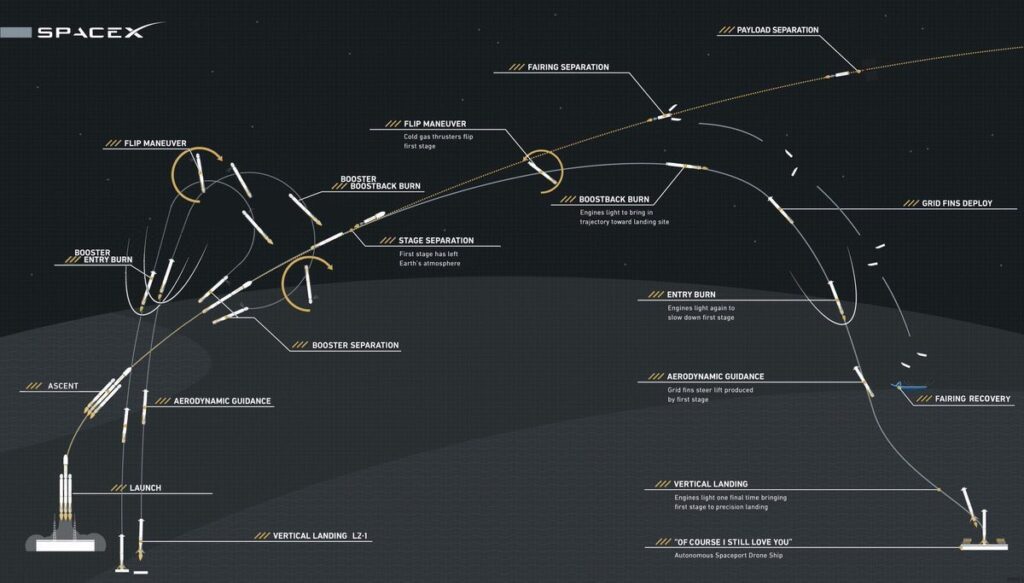
Because it remains attached to the vehicle for much longer than the side boosters, the center core experiences significantly greater aerodynamic heating, velocity, and structural stress, making it the most demanding of the three first stage cores. To maximize payload performance on operational missions, SpaceX now routinely expends the center core while recovering the two side boosters, balancing mission capability with hardware reuse.
Each reusable first stage core carries the same recovery hardware found on Falcon 9, including deployable landing legs, titanium grid fins, cold gas nitrogen thrusters, autonomous guidance software, and the ability to restart its Merlin engines for entry and landing burns. These systems enable controlled atmospheric reentry and precision vertical landings, allowing boosters to be refurbished and flown again on future missions.
Leveraging the Falcon 9 Platform
Perhaps Falcon Heavy’s greatest engineering advantage is its modular design philosophy.
Instead of developing an entirely new platform, SpaceX leveraged the mature Falcon 9 platform by combining three common first stage cores with a largely unchanged Falcon 9 second stage. This high degree of hardware commonality significantly reduced development costs, simplified manufacturing, and accelerated the vehicle’s path to operational service.
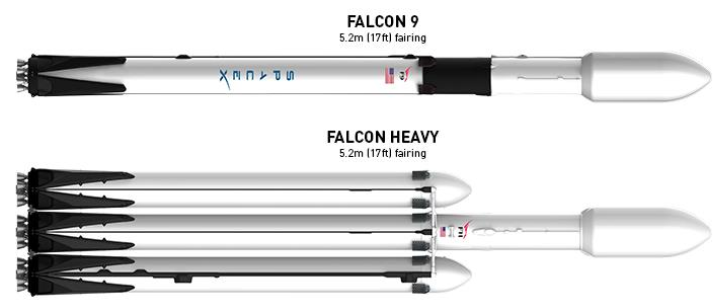
Using proven components also allows SpaceX to streamline production, maintenance, crew training, and launch operations across both Falcon 9 and Falcon Heavy. The shared architecture enables the company to support a diverse range of missions while maintaining one of the lowest launch costs.
By building on an already successful rocket rather than starting from scratch, SpaceX created a powerful launch system capable of carrying some of the world’s largest payloads without sacrificing the economic advantages of reusability.






![Falcon 9 to Launch SDA Tranche 1 Transport Layer A [Scrubbed]](https://thegridfin.com/wp-content/uploads/2026/07/SpaceX_SLC_4E_01-150x150.jpg)