Starlink Mobile’s phone network is getting physical towers already. SpaceX has picked Qualcomm to supply the chips and core software for the Starlink Mobile 5G network, a nationwide U.S. ground network that will work alongside its direct-to-cell satellites. Qualcomm says deployment starts in 2027 and will cover tens of thousands of sites under a multi-year deal.
For anyone weighing Starlink Mobile as a future carrier, the ground side of the network now has a named equipment supplier and a start year, after months of reported tower-lease talks and spectrum deals. Qualcomm called it “our biggest 5G deal yet,” Reuters reported, and didn’t disclose financial terms.
Starlink Mobile is building the first fully-integrated US nationwide satellite and terrestrial network that will keep people connected on their phones no matter where they are. Our 5G base stations will leverage @Qualcomm chips to accelerate deployment, starting in 2027 🛰️📱
— Starlink (@Starlink) November 4, 2026What Qualcomm Is Supplying
The network will run on Qualcomm’s Dragonwing QRU100 radio platform and QDU100 baseband platform, plus Qualcomm’s commercial-grade Layer 1 software. The radios are Massive MIMO units with 64 transmit and 64 receive paths (64T64R), which Qualcomm says are built to improve coverage, capacity and spectral efficiency.
Qualcomm isn’t building the hardware. “We don’t build the boxes,” Durga Malladi, Qualcomm’s executive vice president for technology planning, edge solutions and data centre, told reporters, according to Fierce Network. “They have to build the boxes, but we provide all the components and everything that goes inside that box.” SpaceX handles Layer 2, Layer 3 and the software above the radios.
The technical twist is the band. Massive MIMO usually runs at 3.5 GHz and above, but SpaceX plans to use it at 2 GHz. “What we have done is brought in 64T64R Massive MIMO radios in lower bands all the way down to 2 GHz, so that actually is a unique aspect,” Malladi said. “It’s an innovation from our side.”
Big Towers, Not Small Cells
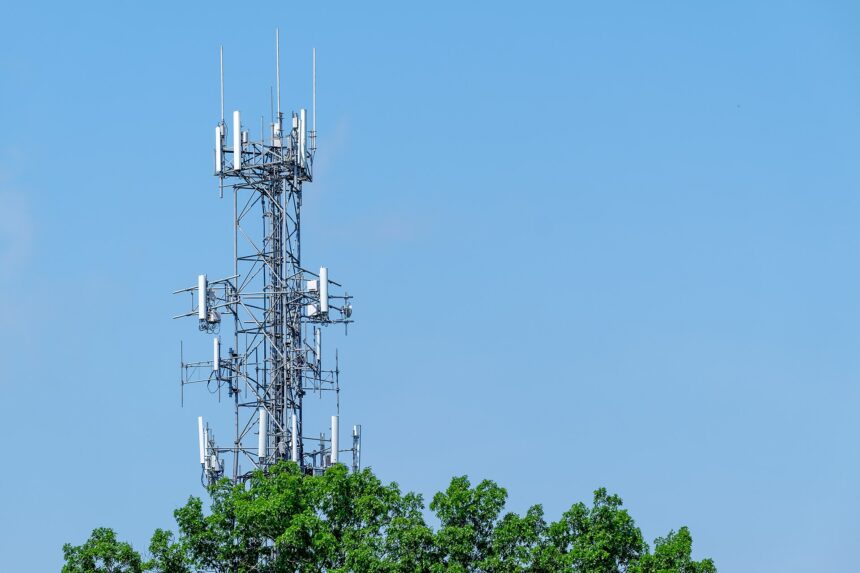
The sites are all macro cells, not small cells, Malladi told Fierce Network. Deployment begins in 2027, and “it’s going to ramp up pretty rapidly from there onwards,” he said.
That matters because SpaceX has floated a cheaper idea: turning Starlink rooftop terminals into small cellular base stations. Joe Madden, principal analyst at Mobile Experts, told Axios the Qualcomm deal signals a commitment to traditional, high-powered infrastructure instead. Madden estimates SpaceX will spend at least $100 billion on its combined satellite and terrestrial network, including spectrum. He expects SpaceX to build more efficiently than Verizon, AT&T or T-Mobile, but questions whether smartphone customers alone can justify the cost.
Where the towers go is still open. SpaceX hasn’t named tower-company partners or said how many new towers it needs, CNBC reported. TGF has covered SpaceX’s interest in 80,000 U.S. cell towers, and Axios noted SpaceX has also held acquisition talks with Boost Mobile.
At last there will be one network with good signal everywhere!
— Elon Musk (@elonmusk) November 4, 20265G First, 6G Later
Both companies pitch this as a starting point. “Together with SpaceX, we are building world-leading cellular infrastructure in the United States, advancing 5G today, with an opportunity to lay the foundation for AI-native 6G in the years ahead,” Malladi said in Qualcomm’s release. Michael Nicolls, senior vice president of Starlink, said in the same release that Qualcomm’s platform will help SpaceX “accelerate our timeline to develop our base station end-to-end architecture.”
For Qualcomm, it’s a push beyond phone chips. For SpaceX, it turns a carrier ambition built on spectrum buys and satellites into a ground network with a supplier, an architecture and a start date. Pricing and a launch date for Starlink Mobile phone plans haven’t been announced.