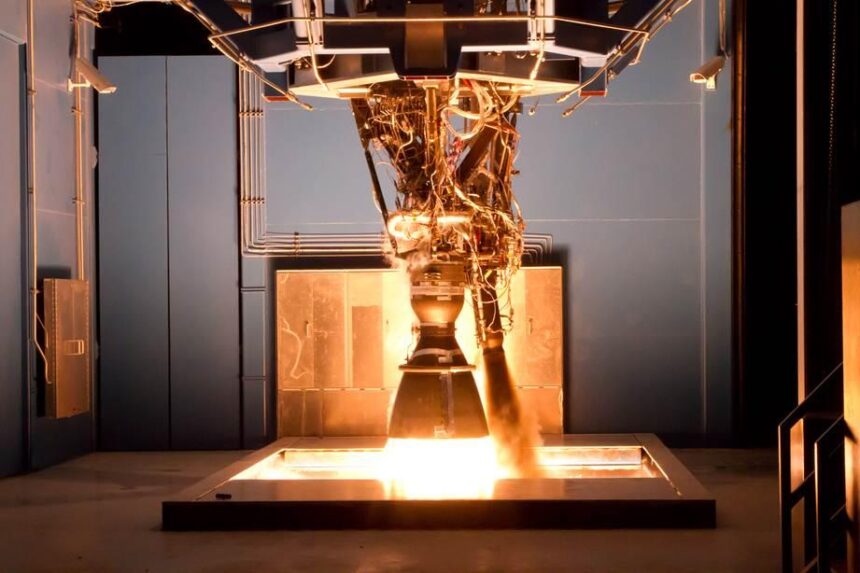
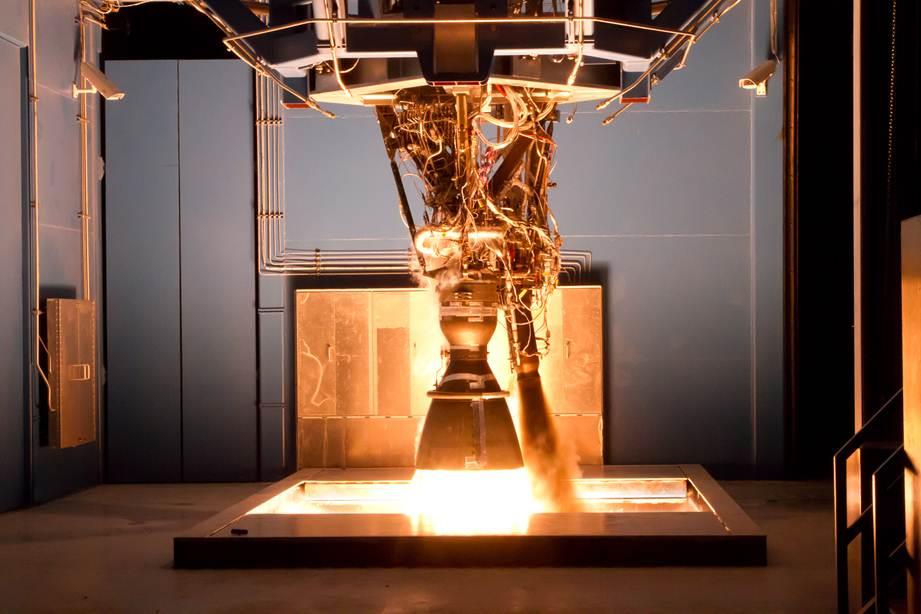
The Merlin engine is the foundation of Falcon 9’s propulsion system. Rather than relying on a single large engine, the rocket uses nine Merlin engines on its first stage and a single vacuum optimized Merlin on its second stage. This clustered, independently controlled design gives Falcon 9 high performance while providing built-in redundancy.
Over years of continuous refinement, SpaceX evolved the original design into the Merlin 1D used today. Designed with reusability in mind, Merlin operates on a gas-generator cycle, a relatively simple and proven rocket engine architecture. Despite its mechanical simplicity, the engine combines high thrust with deep throttling, thrust vectoring, and engine-out capability, allowing Falcon 9 to continue its mission even if one of its first-stage engines fails.
How Merlin Produces Thrust
Falcon 9 runs on KeroLOX, a combination of liquid oxygen (LOX) as the oxidizer and RP-1, a highly refined form of kerosene, as the fuel. A high-pressure turbopump rapidly feeds both propellants into the engine’s combustion system.
To power this turbopump, Merlin uses a gas-generator system in which a small portion of the propellant is burned separately to produce hot, high-pressure gas. This gas drives a turbine which provides the power needed to maintain a continuous flow of propellant into the engine.
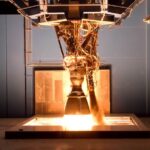
The main propellant flow then enters the combustion chamber, where KeroLOX is mixed and burned at high pressure. The resulting hot gases expand through the nozzle, converting the energy of combustion into an exhaust plume and, ultimately, thrust.
While the gas-generator cycle is less efficient than staged combustion cycles because some propellant is diverted to power the turbine, its simpler architecture reduces mechanical complexity. For an engine designed to fly repeatedly, that simplicity is an important advantage, contributing to a system that is easier to develop, operate, and maintain.
Inside the Combustion Chamber
In addition to generating thrust, the engine must also maintain stable combustion while managing extreme heat and pressure.
Merlin uses a pintle injector to deliver KeroLOX into the combustion chamber in a controlled pattern. The design provides inherent combustion stability while allowing the propellants to mix efficiently. To handle the extreme thermal loads, Merlin uses regenerative cooling. Before entering the combustion chamber, RP-1 flows through passages surrounding the thrust chamber and nozzle, absorbing heat that would otherwise damage the engine. The thrust chamber and nozzle also use a high-conductivity copper-alloy liner to efficiently transfer heat into the cooling propellant.
Why Falcon 9 Uses Nine Engines
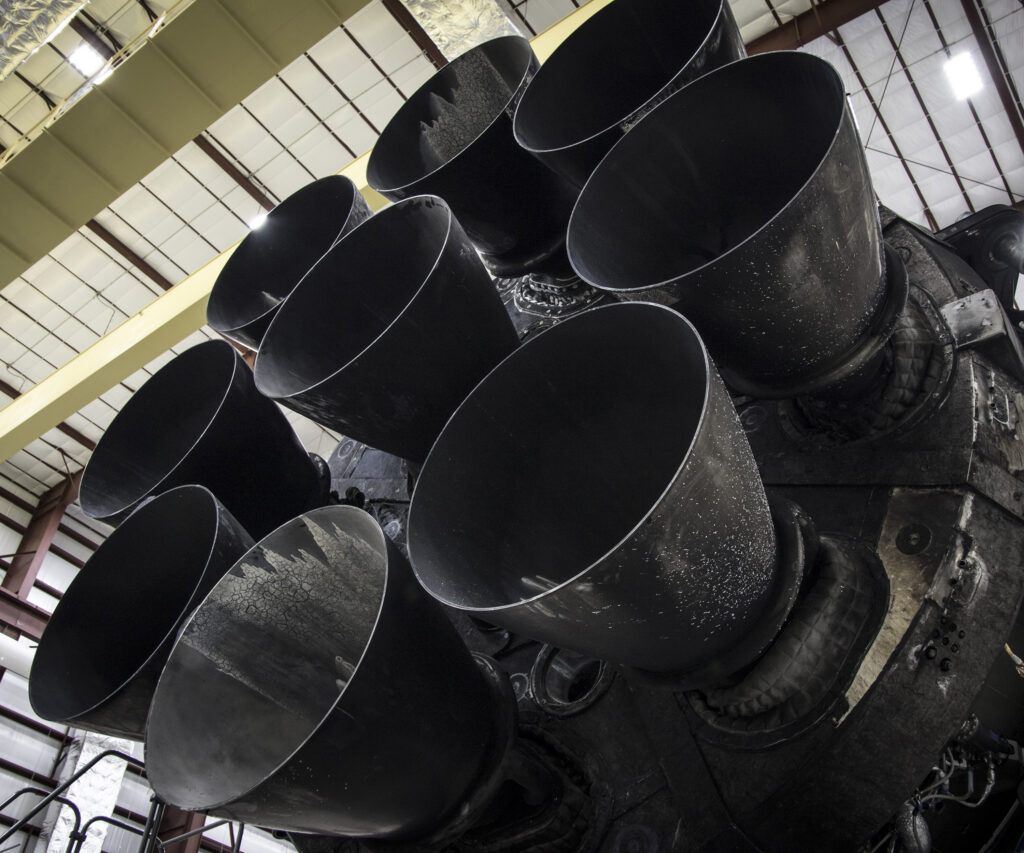
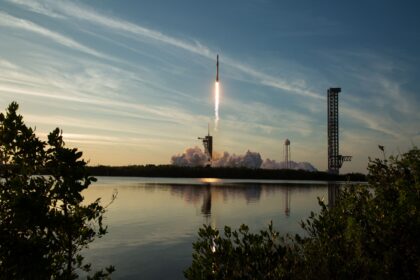
The first stage arranges nine Merlin 1D engines in a circular pattern, with eight engines surrounding a central engine. The arrangement, known as the “Octaweb,” forms the structural heart of the first-stage engine section. Each Merlin 1D produces up to 845 kN (190,000 lbf) of sea-level thrust, giving Falcon 9 approximately 7,605 kN (1,710,000 lbf) at liftoff. Comparatively, Falcon Heavy is powered by 27 Merlin engines, providing 22,819 kN (5,130,000 lbf) of thrust at liftoff.
This clustered approach eliminates the need for a single massive engine while providing important advantages in flight control and redundancy. Each engine can be throttled and gimballed independently, allowing the vehicle to control its trajectory during ascent. If an engine fails during flight, Falcon 9 can compensate with the remaining engines and, under suitable conditions, continue the mission. The system has demonstrated this capability in flight, including the loss of a Merlin 1C engine during the CRS-1 mission while the remaining eight engines continued to deliver the payload to orbit.
Integrated Flight Control Systems
The Merlin engines do more than provide thrust, they are an integral part of Falcon 9’s flight control system. Mounted with the Octaweb arrangement, the engines gimbal to direct thrust away from the rocket’s centerline, providing precise pitch and yaw control. Independent engine throttling allows further control alongside gimbaling.
SpaceX also engineered the engine’s propellant system for dual use, with RP-1 from the turbopump serving as the hydraulic fluid for the gimbal actuators before being recycled into the engine. This eliminates the need for a separate hydraulic power system, reducing hardware complexity and removing the risk of depleting a dedicated hydraulic fluid supply.
Bringing the Booster Home
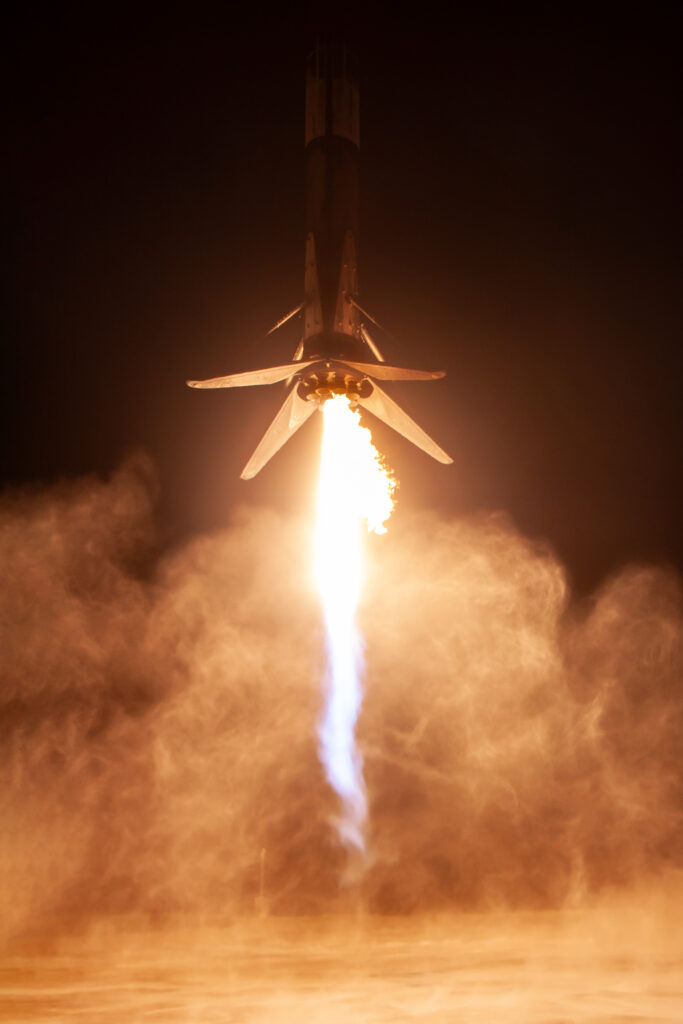
The same engines that launch Falcon 9 are also responsible for bringing its first stage back to Earth. Following stage separation, selected Merlin engines can reignite for the boostback and entry burns, while a single engine performs the final landing burn.
Merlin’s ability to throttle deeply allows the landing engine to precisely control its thrust during the final descent, enabling a controlled propulsive landing. To support reusability, the engines are designed to withstand repeated starts, extreme thermal loads, and the aerodynamic stresses experienced during atmospheric reentry.
SpaceX originally designed Merlin with recovery and reuse in mind, making engine durability a central part of the architecture. SpaceX continues to validate every Merlin engine used on Falcon 9 and Falcon Heavy through ground testing.
Merlin Vacuum: Tailored for Space
While the first stage operates within Earth’s atmosphere, Falcon 9’s second stage uses a single Merlin Vacuum (MVac) engine optimized for operation in space.
The MVac shares the same kerolox propellant combination and gas-generator architecture as its sea-level counterpart, but features a much larger nozzle designed to allow the exhaust gases to expand more efficiently in the vacuum of space. Producing approximately 981 kN (220,500 lbf) of vacuum thrust, the engine can restart multiple times during a mission, allowing Falcon 9 to deploy payloads into different orbits.
A Unified Engine Family
Merlin isn’t just an engine; it is the cornerstone of the Falcon 9 launch architecture.
From providing more than 1.7 million pounds of liftoff thrust and precise flight control to powering orbital insertion and booster recovery, the Merlin family operates across almost every major phase of Falcon 9’s flight. By building a reusable launch system around a relatively simple and highly refined engine architecture, SpaceX transformed Falcon 9 from a conventional expendable rocket into one of the most frequently flown and reusable orbital launch vehicles in history.