By using this site, you agree to the Privacy Policy.
Accept
The Grid FinThe Grid FinThe Grid Fin
  • Rockets
  • Starlink
  • xAI
  • Tech and Patents
Search
Reading: SpaceX Falcon Heavy Launched NASA’s Roman Telescope
Share
Font ResizerAa
The Grid FinThe Grid Fin
Font ResizerAa
  • Home
  • Rockets
  • Starlink
  • xAI
  • Tech & Patents
Search
  • Rockets
  • Starlink
  • xAI
  • Tech and Patents
Follow US
The Grid Fin > Rockets > Falcon Heavy > SpaceX Falcon Heavy Launched NASA’s Roman Telescope
Falcon HeavyRockets

SpaceX Falcon Heavy Launched NASA’s Roman Telescope

By
Karan Singh
Published: 1 September 2026
Last updated: 1 September 2026
3 Min Read
SHARE

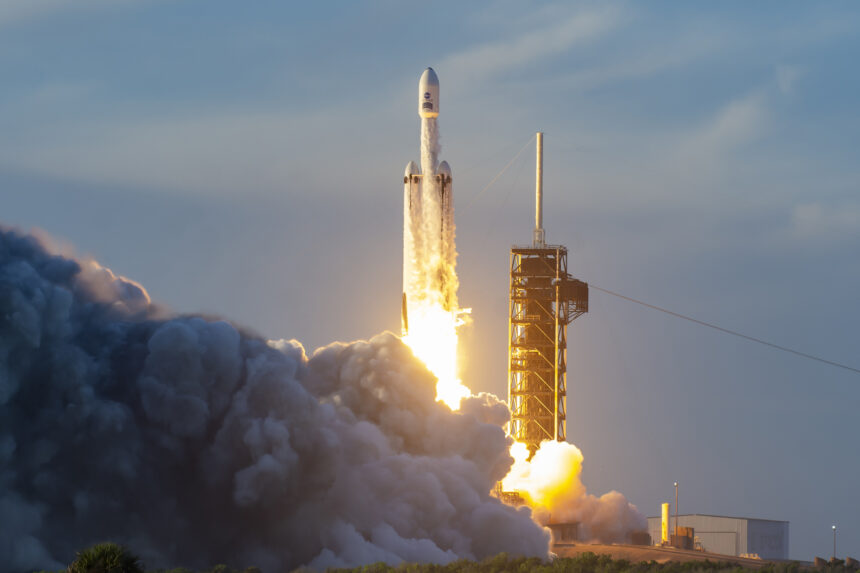
NASA and SpaceX successfully launched the Nancy Grace Roman Space Telescope at 7:26 a.m. EDT Sunday aboard a Falcon Heavy from Launch Complex 39A at Kennedy Space Center. According to NASA, the Falcon Heavy performed as expected, with the observatory successfully separating 31 minutes into flight and both side boosters subsequently returning to the launch site for refurbishment.

Contents
  • Off the Pad, On Its Own
  • What Roman Is Built to Do

Liftoff! @NASARoman begins its flight to space. The Roman telescope’s wide field of view will generate never-before-seen images, revolutionizing our understanding of the universe. pic.twitter.com/tWGW14hohO

— NASA (@NASA) August 30, 2026

Off the Pad, On Its Own

Ground controllers at NASA’s Goddard Space Flight Center in Greenbelt, Maryland, established initial communications through a NASA Tracking and Data Relay Satellite seven minutes after liftoff, receiving telemetry at 7:33 a.m. EDT. Roman then completed spacecraft separation from the upper stage at 7:57 a.m. EDT, embarking on a three-month cruise toward its target orbit around the second Sun-Earth Lagrange point, L2, roughly 1,500,000 km (1,000,000 mi) from Earth.

Acquisition of signal confirmed for our @NASARoman telescope. We have spacecraft separation, and a last look at Roman, now flying on its own. https://t.co/ZKTzQCAGxC pic.twitter.com/IOuHw9MYwr

— NASA (@NASA) August 30, 2026

NASA confirmed that the spacecraft’s solar panels and lower instrument sunshade deployed an hour and 23 minutes after launch. Controllers are preparing to deploy the high-gain antenna and aperture cover, alongside executing the first of two planned mid-course trajectory corrections.

This was the fourth primary payload NASA’s Launch Services Program has flown on Falcon Heavy, after Psyche, GOES-U, and Europa Clipper. NASA said the program worked with SpaceX earlier this year to pull the launch forward so the telescope could fly once it was finished, nine months ahead of the original schedule.

What Roman Is Built to Do

NASA named the telescope after its first chief astronomer, Nancy Grace Roman, regarded as the mother of the Hubble Space Telescope. With a field of view at least 100 times larger than Hubble’s, Roman utilizes infrared imaging to survey the sky far faster than its predecessor from L2. Roman’s primary surveys will focus on dark matter, dark energy, and exoplanets, with room for a lot of other astrophysics surveys.

The mission has a five-year primary lifetime and a goal of operating for 10 years. NASA intends to publicize scientific data after processing following the initial three-month commissioning period. NASA expects first images to be available by early 2027.

NASA said Roman will send back 1.4 terabytes of data every day, the highest data rate of any NASA astrophysics mission so far. First light still sits on the other side of commissioning.


SpaceX Lifts Booster 21 to Pad 2 Tower for Catch Tests
How a Starship Flight Works
SpaceX Patent: How Starlink Handoffs Keep You Connected
SpaceX Patent Could Make Starlink Antennas Cheaper
Starlink V3 Explained: More Capacity, Beams and Bandwidth
TAGGED:Falcon HeavyLaunchNASARoman TelescopeSpaceX
Share This Article
Facebook Copy Link Print
Share
Previous Article Starlink Tightens Roaming and Drops Global Roam
Next Article Grok Bot Launches Shareable Templates

Latest Articles

SpaceXAI Shows How to Run Multiple Grok Bot Teams
Grok xAI
xAI Publishes Official Grok Bot Guides
Grok xAI
Official Starlink satellite illustration over Earth
Starlink Mobile to Launch in Hungary and Albania with 4iG
Starlink
Starlink Now Available in the UAE
Starlink

Popular This Week

  • xAI Publishes Official Grok Bot Guides

    4 September 20262 views
  • Grok Bot now works with X, official SpaceXAI announcement image

    Grok Bot Adds X Connector for Posts and Mentions

    30 August 20262 views
  • Grok Bot Can Now Buy Things via Stripe Link

    31 August 20261 views
  • SpaceXAI Shows How to Run Multiple Grok Bot Teams

    5 September 20260 views
  • Official Starlink satellite illustration over Earth

    Starlink Mobile to Launch in Hungary and Albania with 4iG

    3 September 20260 views

You Might also Like

General News

What is Dragon?

Kevin Y
7 Min Read
RocketsStarship

Starship V3 Explained: What Changed for Flight 12

Kevin Y
5 Min Read
RocketsStarshipSuper Heavy Booster

Super Heavy Booster 21 Rolls to Pad 2 for Flight 14

Kevin Y
3 Min Read

Independent news and analysis covering SpaceX, Starlink, xAI, rockets, artificial intelligence, and the technologies shaping what comes next.

About Us

  • Advertise
  • Privacy Policy
  • Contact Us
  • Editorial Standards
  • About

Categories

  • Rockets
  • Starlink
  • xAI
  • Tech and Patents

More Categories

  • Falcon 9
  • Falcon Heavy
  • Starship
  • Super Heavy Booster
  • Software Updates
  • Grok
Follow US
© The Grid Fin, 2026