Brussels may move fast on Europe’s answer to SpaceX. The EU is preparing a fast-track antitrust review of Project Bromo, the planned merger of the Airbus, Thales and Leonardo space businesses, Bloomberg reported on Oct. 15, citing one unnamed person.
While Europe can approve or regulate as many things as it likes, it can’t approve its way to a physical satellite constellation in orbit. Building satellites and prophesying communications networks is one thing, but actually putting them into orbit and having a functional network is entirely another.
Fast Tracking Paperwork, Not Satellites
The companies haven’t formally notified the deal yet. According to Bloomberg, a Phase 1 clearance could take just over a month if they offer remedies such as asset sales. Otherwise the EU Commission can open an in-depth probe lasting several months.
Per the companies’ October 2025 announcement, the new company would have about 25,000 staff and roughly €6.5bn in annual turnover, with Airbus owning 35% and Leonardo and Thales 32.5% each. It would combine satellite manufacturing and space services, “from space infrastructure to services (excluding space launchers),” and could be operational in 2027, subject to approvals.
At this point, the announcement hasn’t named any plans for a future rival constellation or launch plans, but it is taking aim at taking on Starlink’s dominance of satellite-served high-speed connectivity, at least over Europe.
Commission President Ursula von der Leyen called the three companies “the types of industrial champions we need.” Competition chief Teresa Ribera has said that “scale, in itself, is not a goal.” Rival OHB has said it would consider legal action if the deal is cleared, based on reporting from Reuters.
Launch is the Bottleneck – Kuiper
Amazon Leo is a perfect example of the problem that the EU faces with its coalition of suppliers. Leo has 396 satellites deployed today, from 14 launches. Another 1,000 Leo satellites sit in warehouses, awaiting launches, with 100 launches booked over the next two years according to Amazon’s statements.
However, its initial FCC license for deployment of its Leo network required 1,616 satellites in orbit by July 30, 2026. Months later, we’re at less than half the number required back in July, and Amazon has requested a limited waiver from the FCC, granted conditionally. The deadline for the full constellation of 3,232 satellites by July 30, 2029 still stands as the target goal.
SpaceX, by contrast, has 11,154 satellites in orbit today, with more launches on a more than weekly basis to replace old satellites, augment the fleet, and begin deploying their next-gen Starlink V3.
Amazon has some of the deepest pockets on Earth and a factory that can now build 27 satellites a week, and it still reached its FCC halfway date with well under half of what it needed. If Amazon can’t buy its way past the launch bottleneck, I don’t see how a European merger does. Bromo doesn’t even include a rocket or launch plans – just supplier capacity.
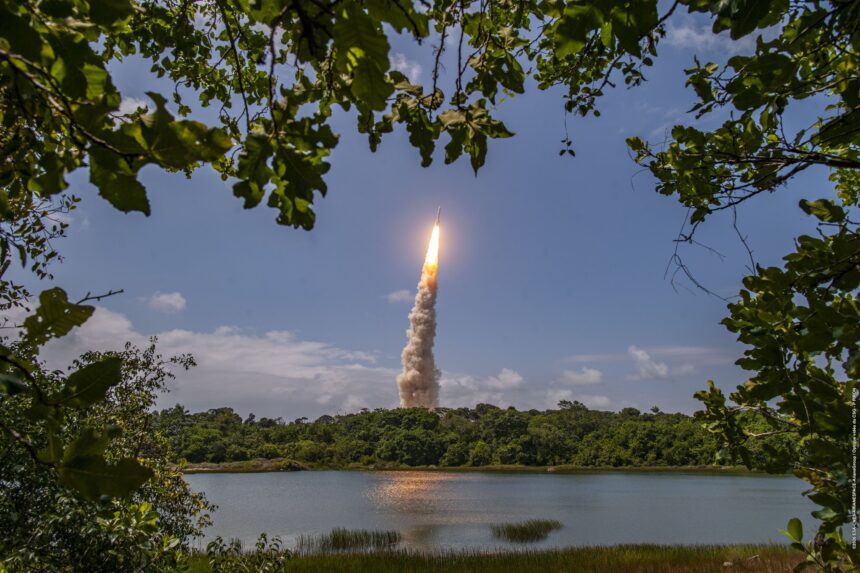
Europe’s own primary rocket is busy anyway. Arianespace’s next Ariane 6 is set to carry 36 Amazon Leo satellites, no earlier than Nov. 23.
Europe’s Real Constellation Is IRIS²
The EU signed the IRIS² concession in December 2024 with SpaceRISE (SES, Eutelsat and Hispasat) for 290 satellites and services by 2030, at a cost then put at €10.6bn. An Aug. 7 agreement grew it to 348 satellites, 330 in low Earth orbit and 18 in medium Earth orbit, with first launches in 2029. SpaceNews puts the total cost at about €15.6bn today, a nearly 50% cost increase. The core subcontractor team the Commission named includes Thales Alenia Space, Airbus Defence and Space, Telespazio and OHB. Three of those are Bromo businesses.
IRIS² is a plan, I’ll give it that. But in under two years its cost has gone from €10.6bn to roughly €15.6bn, and the first launch is still years away. Bromo folds most of its build list into one company, which just consolidates the suppliers, rather than changing the game in any meaningful way.
What Counts as Reuse
ArianeGroup, which builds the Ariane 6 rocket, posted this on Oct. 16:
🚀 A single Prometheus® engine is designed to be reused up to 5 times, with multiple ignitions possible during a mission and across successive flights.
Which aspect of reusability impresses you most: durability, multiple ignitions or cost reduction?#RocketMakers #Civil… pic.twitter.com/5mOTlyMvKC
— ArianeGroup (@ArianeGroup) October 16, 2026Prometheus hasn’t flown on an orbital rocket, and its test bed, ESA’s Themis demonstrator, hasn’t made its first hop yet. Ariane 6’s solid boosters “are not reusable: they are designed for a single flight,” Arianespace says. Meanwhile, booster B1067 flew its 37th mission on Aug. 25. That’s just a few more than five uses, by my last count.
ArianeGroup’s big reuse flex this week is an engine that’s designed to be reused up to five times, on a test platform that hasn’t even left the ground yet. A single Falcon 9 booster has flown 37 times. I’d call that reuse.
The Case for Bromo
IRIS² isn’t trying to beat Starlink on subscribers, so a smaller, pricier system can still meet its goal to provide a sovereign-controlled network service. With Ariane 6 flying small constellation batches in the future, there is potential, but right most of those launches are already bought up by Amazon, so where will Europe get the rockets to put IRIS² into orbit?
One stronger, singular prime supplier may beat three subscale ones, but the fact here is that Europe isn’t satellite restricted, its launch-restricted, and its singular best launch provider believes reuse is limited to just a few uses on a prototype platform.
SpaceX is nearing the retirement of its trustworthy Falcon 9 platform, while competitors are still trying to figure out where they’re going to go with reuse.